.svg)
Validate a Startup Idea Before Building an MVP

.jpg)
- Talk to real people and write falsifiable hypotheses. Before building an MVP, run structured interviews to confirm that your target audience experiences repeated pain, uses clumsy workarounds and acknowledges the cost of the status quo. Formulate assumptions as testable statements with measurable outcomes.
- Run low‑code tests to prove demand and pricing. Create landing pages, fake doors and waitlists; run tiny ad campaigns and measure conversion rates (target ≥3% from qualified traffic and ≥ 5% clicks on a fake feature). Test willingness to pay with deposits or pre‑orders and prioritise core features using the MoSCoW method.
- Use a scorecard to decide if it’s time to build an MVP. Evaluate evidence across problem severity, audience clarity, pricing signals, channel fit and early traction. Look for 5+ interviews confirming pain, anding‑page conversion, at least a handful of pre‑orders and a clear acquisition channel. Only then commit to an MVP.
Every founder starts with a belief. The problem is, belief is not evidence. Before you build anything, you need proof that your idea solves a real and urgent problem. Startup idea validation is the process of turning assumptions into facts. It forces you to test demand, pricing, and distribution before writing a single line of code. Too many founders rush to build and discover later that interest does not equal commitment. Validation helps you avoid that mistake.
In this guide, you’ll learn how to test your riskiest assumptions first, what strong evidence actually looks like, and when you truly have enough signal to build an MVP with confidence.
What does “validation” mean?
Validation is about gathering evidence that your concept solves a real problem and that people will pay for it. This is distinct from market research and from product‑market fit. Idea validation happens before a product exists; it determines whether a concept could work in the market. Market research collects data to better understand the market and is an important input to idea validation. Product‑market fit occurs later; it’s the confirmation that a real product has demand and traction within a target market.
Polite feedback does not equate to validation. Asking friends if they “like” your idea yields interest but not commitment. Real evidence comes when a prospect invests something they cannot easily take back – time, a referral, or money. The commitment ladder helps separate noise from signal. At the bottom rung sits polite interest (“That sounds interesting”), and at the top rung sits payment (“I want to buy this now”). Your goal is to move prospects up the ladder.
Start with a falsifiable hypothesis
Begin by writing down your riskiest assumptions. This is the foundation of how to validate your startup idea properly. Each assumption should be formulated as a falsifiable hypothesis, a specific, repeatable action that leads to an expected measurable outcome. For example:
“If we add a video walkthrough to our landing page, then 10% more visitors will sign up for the waitlist within one week.”
Writing hypotheses in this form forces clarity and creates a clear pass/fail threshold. The format can be as simple as “Specific action → expected outcome”. If you cannot phrase it this way, rewrite the assumption or narrow your focus. Remember that hypotheses exist to be disproved; validation should be about learning, not confirmation bias.
Document your hypotheses around four key areas: the problem, the customer, the value, and the channel. For each, state what would convince you to abandon or refine the idea. Examples:
- Problem hypothesis: Early‑stage founders spend 5+ hours weekly cobbling together spreadsheets and manual processes to manage investor updates.
- Customer hypothesis: Our initial customers are seed‑stage founders in fintech hubs such as London and Berlin.
- Value hypothesis: Founders will pay at least £50/month for a tool that automates investor reporting.
- Channel hypothesis: Most of our early sign‑ups will come from LinkedIn and founder communities (e.g., Tech Nation).
Having these hypotheses written down helps prevent moving the goalposts later.
Talk to people before you build anything
Lean validation starts with a conversation. Conduct problem interviews with 5–10 people who match your customer profile. The goal is to verify that the problem is painful, frequent and costly. Avoid pitching your solution. Instead, ask about recent behaviour:
- “Who is involved when this problem happens?”
- “Walk me through the last time, what triggered it? What did you do?”
- “What broke or frustrated you about current tools?”
- “What have you paid (money or time) to address it?”
Pass criteria for problem interviews: at least five people independently report the same pain, describe inadequate workarounds and indicate urgency or budget. Capture not just quotes but patterns: How often does the problem occur? What is the cost of inaction? Are prospects already paying for a workaround? If you cannot find evidence of repeated pain, revisit your problem hypothesis.
Prove demand with low‑lift tests (no code first)
Once you’ve heard the same problem multiple times, move from conversation to experiments. These tests are designed to simulate parts of the user journey without writing code. Here are several evidence‑generating experiments and what they prove:
| Validation method | What it proves | Set up a metric |
|---|---|---|
| Landing page / fake door | Measures demand and value proposition clarity. A "fake door" is a call‑to‑action for a feature that does not yet exist. | Build a simple page describing your solution and a pricing anchor. Send qualified traffic and track sign‑ups. Pass when 3–10% of visitors convert, and ≥5% click on the fake feature. |
| Waitlist + pricing anchor | Gauges interest and gathers early leads. | Add a sign‑up form with a suggested price (e.g., "Join the waitlist for £50/month"). Measure the percentage of visitors who sign up. |
| Concierge test | Validates product/service delivery with manual effort. | Deliver the service manually while openly communicating with users. Learn what steps truly matter before automating. |
| Wizard‑of‑Oz prototype | Tests user experience while hiding manual effort. | Simulate automation behind the scenes; users think it's a working product. |
| Content‑led demand | Tests if your target audience cares about your problem. | Publish blog posts, guides or community threads addressing the problem. Measure engagement (comments, shares, sign‑ups). |
| Tiny ad campaigns | Validates whether a channel can reach your audience profitably. | Spend £50–150 on Google or Meta ads targeting your persona. Measure click‑through rate (>1.5%) and cost‑per‑lead; a good landing‑page conversion rate is ≥3%. |
| Summary: Each validation method tests a different assumption — from demand and pricing to delivery and channel fit — allowing founders to reduce risk before committing to a full build. | ||
Each experiment should have a clear goal, set‑up steps, and a pass/fail metric. Avoid running multiple experiments at once; you want isolated signals. Remember that you are testing behaviour (sign‑ups, clicks, payments) rather than opinion.
Validate willingness to pay (not just interest)
Interest is easy to get; payment is harder. Pricing is one of the most neglected aspects of validation. Asking “How much would you pay?” rarely yields accurate data. Instead, look for behavioural signals:
- Pre‑orders: Offer a paid pre‑order at a discount or with a founding‑member perk. Even a few pre‑orders confirm willingness to pay.
- Deposits: Ask for a small refundable deposit (£1–£5). Deposits show commitment even if refundable.
- Pricing experiments: Run A/B landing pages with different price points and measure conversion. Pass when you see at least 5% of sign‑ups placing a deposit or pre‑order.
- Letters of intent or pilot agreements: In B2B contexts, ask for a signed letter of intent (LOI) or a paid pilot. This sits near the top of the commitment ladder.
Where prospects fall on the commitment ladder tells you how real the opportunity is. A simple email sign‑up is a low‑stakes signal; a paid pilot is a strong signal. Aim to move prospects up the ladder by increasing the level of commitment requested over time.
Validate the distribution before the product
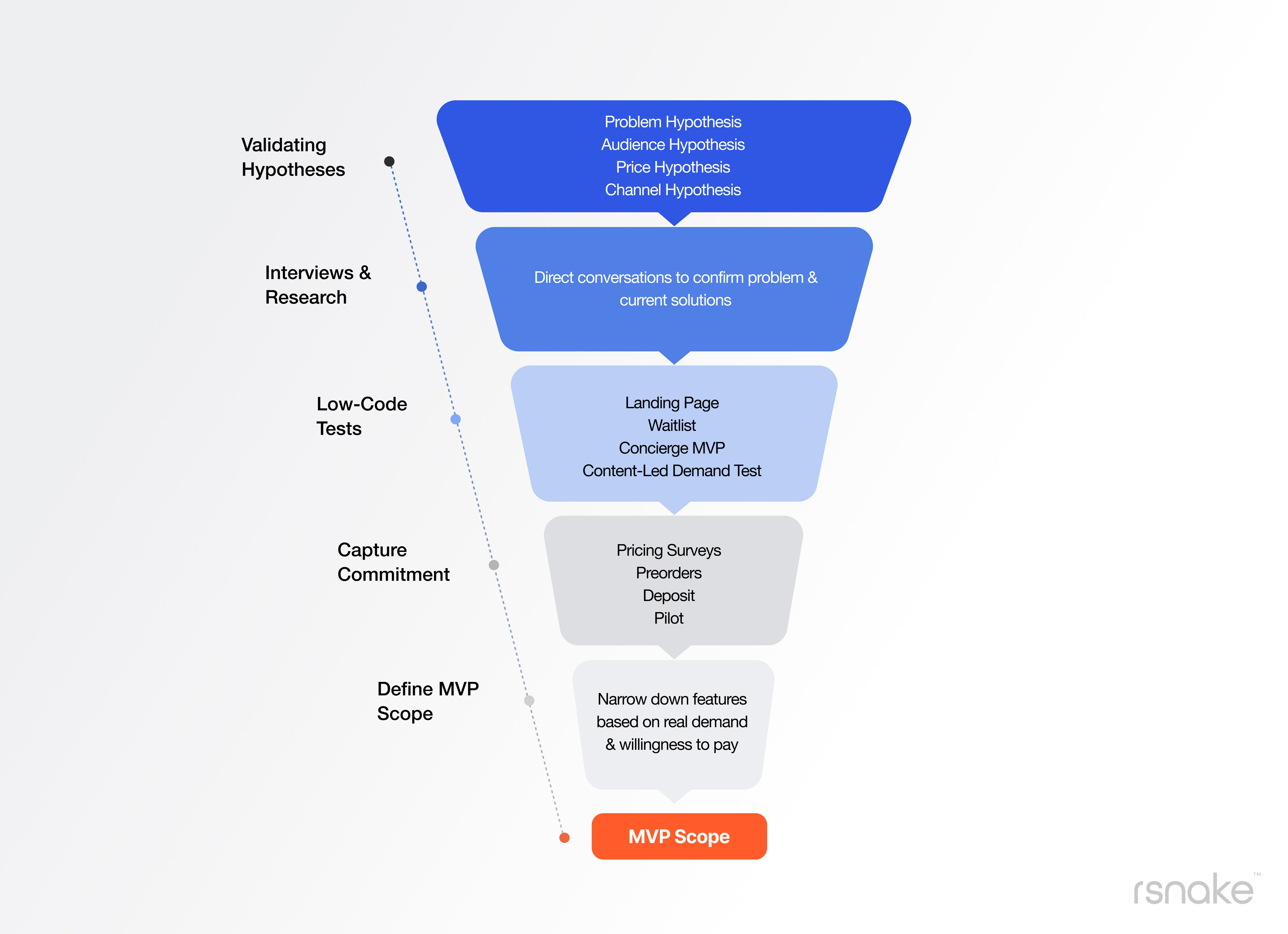
A great product without distribution fails. Many founders assume that “if it’s better, people will find it,” but distribution is the missing half of most startup plans. To ensure channel–product fit:
- Pick 1–2 primary channels and write a weekly plan. Ask how your buyer reduces risk: if they search for a solution, SEO and content might be effective; if trust is the barrier, partnerships and referrals may work better.
- Run quick channel experiments. For each channel, define one number to move (e.g., 15 sales calls booked), list inputs you control (e.g., 40 outbound messages, two partner intros, one article), run a small change (headline, target audience) and review results each week.
- Check channel economics. A channel isn’t good because it works for someone else; it’s good when its economics work for you. Factor in customer acquisition cost (ad spend, sales time, tooling), saturation (channels get crowded and costs rise) and compounding effects (SEO, partnerships and communities become cheaper over time). Ensure you can afford the channel until retention pays you back.
If you cannot reliably acquire customers at a cost that makes sense, revisit your channel hypothesis or rethink your idea. Distribution risk should be tested before you commit to building.
Decide if you’re ready to build an MVP
Use a validation scorecard to decide whether to move from experiments to product development. Score each criterion on a simple scale (e.g., 0–3), where 0 means no evidence, and 3 means strong evidence. Here’s an example:
| Criterion | Metric | Pass threshold | Notes |
|---|---|---|---|
| Problem severity | Number of interviews confirming pain | ≥ 5 interviews reporting painful, frequent, costly problem | Look for common triggers, current workarounds and the cost of inaction. |
| Audience clarity | Defined customer persona | Clear ICP with demographic and behavioural traits | You should know exactly who you are targeting (role, industry, budget). |
| Demand signal | Landing‑page conversion | ≥ 3% from qualified traffic; ≥ 5% click on fake feature | Lower conversions suggest value proposition confusion. |
| Pricing signal | Deposits / pre‑orders / LOIs | ≥ 5% of sign‑ups place a deposit; at least a handful of pre‑orders | Actual money is the strongest signal. |
| Channel fit | Channel experiment results | Identified the primary channel with a repeatable playbook | If you cannot describe how you will get customers every week, your channel isn't validated. |
| Retention proxy | Repeat interactions (subscriptions, follow‑ups) | Early adopters repeatedly use your manual service or share referrals | Signals that your solution has enduring value. |
| Summary: Total your scores. If most criteria are at or above 2–3, you likely have enough evidence to build your MVP. If scores are mixed, narrow your segment, adjust your value proposition, or run more experiments before committing. Do not move forward because you're tired of testing; move forward because you have evidence. | |||
Total your scores. If most criteria are at or above 2–3, you likely have enough evidence to build MVP. If scores are mixed, narrow your segment, adjust your value proposition, or run more experiments before committing. Do not move forward because you’re tired of testing; move forward because you have evidence.
What to build first (turn evidence into an MVP scope)
When evidence supports your hypotheses, translate insights into a minimum viable feature set. An MVP is a simplified version of your product that focuses on essential features and solves a single core problem. The MoSCoW framework helps prioritise features:
- Must‑haves: Core functionality required to deliver the primary value.
- Should‑haves: Important but non‑critical features that can improve the experience.
- Could‑haves: Nice‑to‑have features that can be deferred.
- Won’t‑haves: Features to exclude for now.
Focus on one top‑priority feature that conveys the product’s core value. Built with agile methodologies, breaking work into sprints. Incorporate user feedback through prototypes and closed betas. Keep your feature set lean; avoid the temptation to overload the MVP. Use tools like Figma, Miro and component libraries to speed up design and maintain consistency.
Define success metrics for the MVP: activation (first meaningful use), retention (continued use or repeat purchase) and conversion to paid plans. Track these metrics with analytics tools so that you can iterate quickly.
How Rattlesnake Group run validation sprints?
At Rattlesnake Group, we believe founders should validate before they build. Our boutique studio in central London is founder‑led; our co‑founders personally oversee every project. We work with startups from founders to founders, offering one‑on‑one in‑person meetings and a dedicated project manager for each engagement. Here’s how our validation sprint typically works:
- Week 0–1: Discovery & research. We align on your vision, define the problem hypothesis and customer persona, and conduct market and competitor research. Together, we brainstorm strategies in a structured workshop and map out a timeline.
- Week 2: Customer interviews. We recruit participants who fit your ideal customer profile and run structured problem interviews. We synthesise patterns of pain, frequency and current workarounds into actionable insights.
- Week 3: Low‑code tests. Our design team creates a landing page and fake‑door experiment, while our growth team runs tiny ad campaigns to drive traffic. We capture sign‑ups, conversion rates and early pricing signals.
- Week 4: Pricing & channel tests. We test price sensitivity with deposits and pre‑orders and run channel experiments to measure CAC and channel fit. We refine the message, channel and audience based on the data.
After the sprint, we deliver a validation report summarising research insights, test results, a scorecard evaluation and an evidence‑based MVP scope. If the evidence is strong, we can move into MVP development.
Our internal libraries and modular architecture accelerate time to market by 2.5×, and we typically deliver a high‑quality MVP within 4–12 weeks. Throughout development, only senior professionals work on your project, ensuring quality and efficient decision‑making.
Book a call and validate before you build.
Mikael is the Managing Partner at Rattlesnake. With a background in strategy and consulting, he oversees the company's strategic direction, leads key client partnerships, and drives growth through high-impact collaborations.


Ready to start?
Send us an email with your project details, and our team will connect with you within 24 hours to schedule a call.


© 2020-2026 Rattlesnake Group Limited.
Rattlesnake Group Limited is a limited liability company registered in England and Wales. Registered number: 12551349. Registered address: 124 City Road, London EC1V 2NX. VAT Registration Number: 436362592.


