.svg)
Startup Messaging Framework: How to Structure Your Key Messages

- Clarity builds trust and traction. A startup messaging framework acts as a blueprint for how your company talks about itself. It defines what you stand for, what problems you solve and how you communicate value to customers, investors and partners.
- Consistency across channels drives conversion. A well‑structured messaging hierarchy ensures that your core brand promise, supporting messages and proof points are used appropriately on your website, pitch decks, social media and product copy. This cohesion speeds up content creation, improves investor pitches and reduces confusion as you scale.
- Start with your value proposition and evolve it. Effective messaging is rooted in a clear value proposition and positioning. Your positioning explains who you are and what you do, messaging hooks people and explains why they should care, while your value proposition tells them how you’re different and why they should buy. Use research, iterate and refine your messages as your product and audience grow.
Introduction
Great products fail every day, not because they lack substance but because people don’t understand them. In a world where attention spans are measured in seconds, communicating clearly is existential. Yet many early‑stage companies speak in multiple voices: a playful tone on social media, a formal voice in investor decks and jargon‑filled copy on their home page. Users and investors come away confused, and promising ideas wither in obscurity.
Think about the last time you landed on a startup site and couldn’t figure out what they actually did. Frustrating, isn’t it? Maybe you’ve faced this yourself, describing your brilliant solution and watching eyes glaze over.
Here’s a relatable scene: a founder stands before a whiteboard covered in sticky notes and diagrams, trying to distil months of hard work into a single sentence. They’re not alone. Successful companies intentionally design how they speak about themselves. They understand that learning how to create key messages for a startup is not just a branding exercise but a survival skill, a way to organise their narrative, align teams and communicate value with precision.
This guide walks you through that process. We’ll define what a startup messaging strategy is, explain why it’s critical, break down its core components and provide a step‑by‑step plan to build your own. You’ll see real examples from high‑growth startups, learn common mistakes and understand how to weave messaging into your brand strategy. The aim? To help you craft messages that resonate with customers, inspire investors and drive growth.
What Is a Startup Messaging Framework?
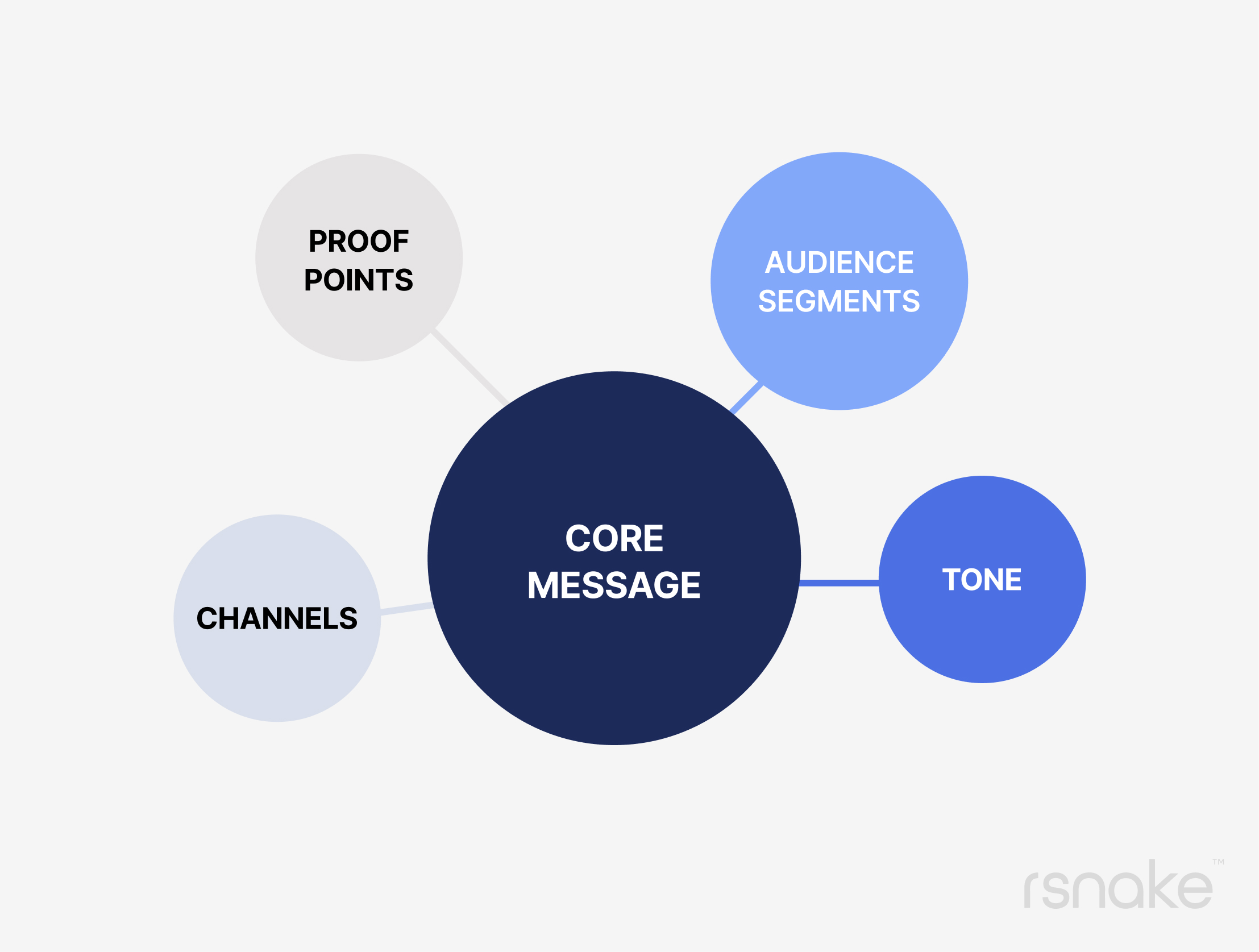
A startup messaging framework is a structured system that organises how a company communicates its value, differentiation and tone. Think of it as a blueprint that guides all written and spoken communication, from your home page and investor decks to social posts and sales calls. A well-defined brand messaging framework for startups ensures every word reinforces who you are, what you stand for and why it matters. The framework brings together several elements:
- Core message: a concise elevator pitch that explains your purpose and impact. Heavybit notes that successful messaging includes a headline benefit (around 25 words) and an elevator pitch of roughly 55 words.
- Key supporting messages: a small set of proof points that expand on the core message and connect to specific customer needs.
- Audience‑specific adaptations: messages tailored to the needs and pain points of investors, customers and partners.
- Tone and voice guidelines: directions on vocabulary, emotional tone and personality so all communications sound like they come from the same brand.
- Channel guidance: advice on adapting the hierarchy for different touchpoints such as websites, emails, ads and product interfaces.
A messaging framework sits between your positioning and your value proposition. Your positioning explains who and what you are, your messaging hooks people in and explains why they should care, and your value proposition shows how you’re different and why people should buy.
While your value proposition is a single promise, “the reason someone should buy from you instead of competitors”, your messaging framework turns that promise into a hierarchy of statements, stories and proof points for different audiences.
Why Words Matter?
Words are how people experience your brand long before they use your product. People make decisions based on whether something will make their lives better or help them avoid a potential problem. Creating perceived value can be as important as creating real value. Reframing what you offer is a powerful tool when markets are saturated in short, narrative matters.
Your messaging framework ensures your narrative isn’t left to chance. It documents how to talk about your startup, so everyone, from founders and marketers to engineers, can communicate consistently.
Why a Messaging Framework Is Critical for Startups
A strong startup messaging framework is about creating shared clarity, speed, and consistency across every part of your business, the foundation of effective startup brand communication.
Clarity and Alignment
Startups often move fast, with multiple people producing content across different platforms. Without a common framework, messaging fragments. The marketing team may emphasise one benefit while the product emphasises another, and sales uses outdated language. A framework provides alignment across product, sales and marketing teams. It reduces internal debates by providing a shared source of truth about what your company stands for and how to express it.
Efficiency and Speed
When content creators know the core message, supporting points and proof, they can produce copy faster. Heavybit recommends distilling your narrative into succinct pieces, headlines, elevator pitches and positioning statements. Having these on hand reduces the time it takes to create blog posts, pitch decks or ads. It also helps new hires ramp up quickly.
Stronger Investor Pitches
Investors hear hundreds of pitches. Clear, consistent messaging helps you stand out and ensures they understand your value proposition immediately. A messaging framework guides how you communicate your mission, vision and differentiators to investors and partners. Proof points and concise language give credibility, showing that you’ve thought deeply about the market and customer needs.
Reduced Brand Confusion as You Scale
As your startup grows and hires new staff, messaging can get diluted. A documented framework helps maintain brand consistency across new channels and regional markets. Fusepoint Insights explains that consistent brand communication can contribute to revenue growth by creating a cohesive experience for customers.
Better Customer Conversion and Retention
Customers don’t just buy products; they buy stories and identities. Clear and consistent messaging builds trust and creates emotional connections. When customers repeatedly hear the same promise and experience it delivered, they’re more likely to become advocates. A structured framework also ensures messaging evolves as your product does, so you don’t over‑promise or under‑deliver.
The Core Components of a Messaging Framework
A complete startup messaging framework brings structure to your story, from the single sentence that defines your purpose to the tone, proof points, and channels that carry it to the world.
1. Core Message (Elevator Pitch)
Your core message, sometimes called an elevator pitch, summarises your brand purpose and impact in one or two sentences. It should align with your unique value proposition and positioning. Limit this statement to around 55 words and ensure it expresses the key benefit your product offers.
2. Key Supporting Messages
Supporting messages expand on the core statement with proof points, benefits and social proof. Each supporting message should connect to a specific customer need or business outcome. For instance, Slack’s website not only proclaims “Be Less Busy” but also emphasises how its platform reduces back‑and‑forth communication and allows integrated workflows.
3. Audience‑Specific Messages
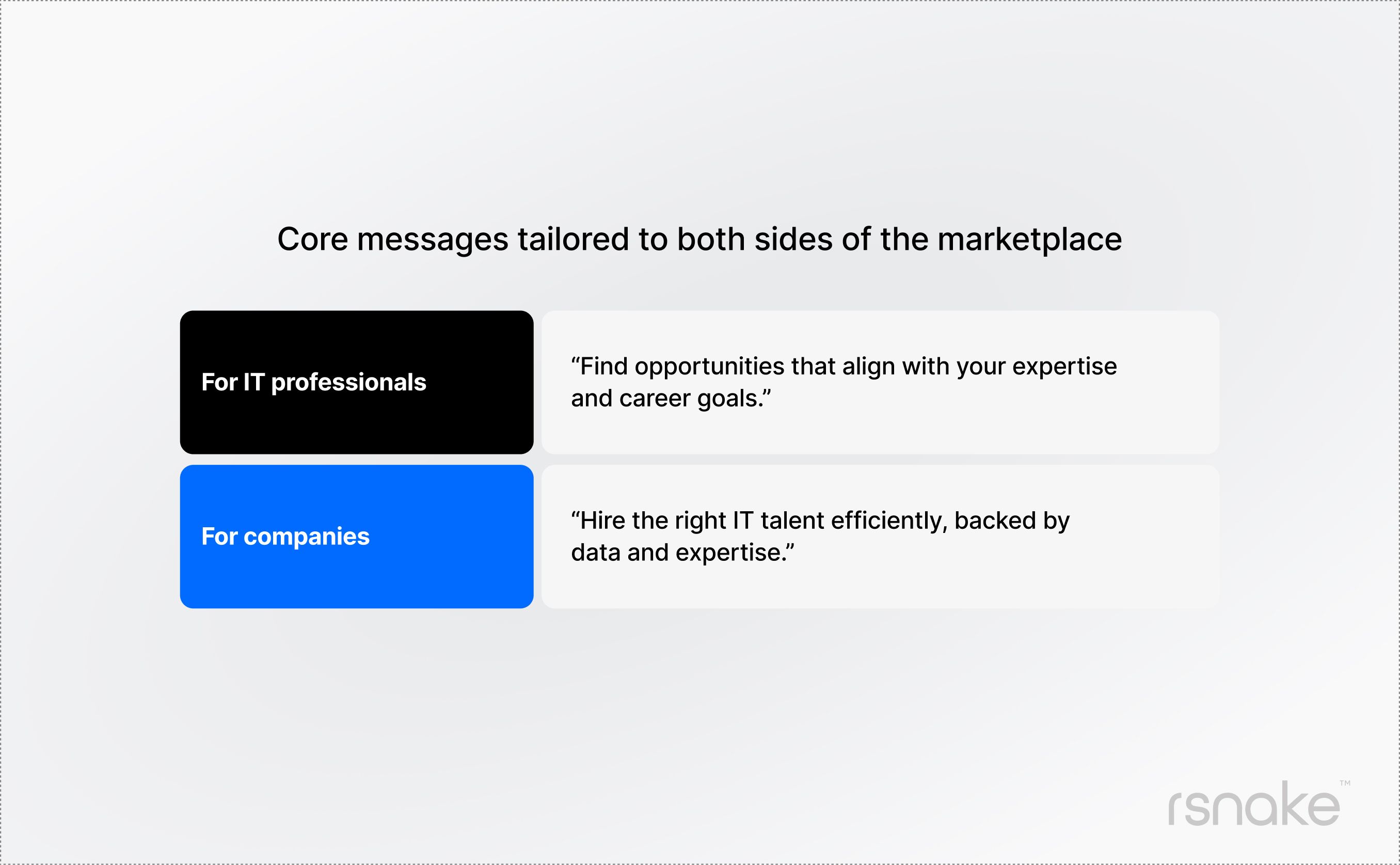
Different audiences care about different things. Investors want to know about market size, traction and scalability, while customers care about solving their specific pain points. Audience‑specific messages adapt the tone and proof points for each group. For investors, emphasise revenue growth, addressable market and differentiators. For customers, focus on ease of use, outcomes and emotional benefits. For partners, highlight integration potential and mutual value.
4. Brand Personality and Startup Tone of Voice
Your brand voice reflects your values and remains consistent, while tone adjusts depending on context. Defining your tone ensures that communications sound human and aligned with your brand identity. For example, a fintech startup might adopt a calm and trustworthy tone, while a gaming platform may embrace energy and humour. Learning how to write brand messages that fit this tone is essential to keeping your communication authentic and on-brand.
Include do’s and don’ts for vocabulary, grammar and humour. Should you use contractions? Do you address the reader directly? What slang is off‑limits? Document these rules so your team can deliver a consistent experience across mediums.
5. Channel Adaptation
The way you express your brand message is consistent and changes with the medium. Your home page might feature a concise tagline and a subheadline, while an investor deck includes deeper proof points and market data. Messaging hierarchy concept positions the most essential brand promise at the top, followed by supporting benefits and proof. Use this ladder to decide what appears in each context. For example:
- Website hero section: Core message and one supporting benefit.
- Blog post: Supporting message, examples and proof.
- Social media: Short, emotional hook plus a call‑to‑action.
- Sales deck: Core message, several proof points, market context and next steps.
How to Build a Startup Messaging Framework
Building your framework is an iterative process that involves research, collaboration and testing. Here’s a step‑by‑step guide.
Step 1: Start with Your Value Proposition and Positioning
Your value proposition is the promise of value that sets you apart from competitors and explains why customers should buy from you. Meanwhile, positioning places your brand in the context of the market by explaining who you are and what you do. Positioning tells the audience what you are, messaging hooks them in, and the value proposition tells them why you’re different and why they should act now
Step 2: Identify Key Audiences and Pain Points
Interview existing customers, prospects and internal stakeholders to understand who you’re serving and what problems they face. Create 2–3 personas that capture demographics, motivations, pain points and objections. Each persona should map to a customer journey stage, e.g., early adopter, mainstream buyer or power user. Look for emotional drivers as well as functional needs. For investors, map out their goals (return on investment, market growth) and concerns (competition, scalability).
Step 3: Develop Your Core Message Statement
Using the research and value proposition, write one or two sentences that summarise your brand purpose. Keep it concise and free of jargon. Ask yourself: would a stranger understand this without context? Would it fit on a billboard? Here are some examples with citations:
- Stripe: “Payments infrastructure for the internet”, a clear, functional promise that positions Stripe as the backbone of online commerce.
- Slack: “Be Less Busy”, a short imperative that addresses the pain of workplace overload and hints at the product’s benefit.
- Calendly: “Easy scheduling ahead” solves a specific frustration with simple language.
- Figma: “Where teams design together”, conveys collaboration and indicates that the tool is for teams, not just individual designers.
Step 4: Build Supporting Messages and Proof Points
For each persona, list 3–5 supporting messages. Each should connect a product benefit to a pain point and include proof. Keep proof points brief (e.g., a customer quote or metric). Use social proof, statistics and specific examples. For example:
- “Designed to schedule meetings without the back‑and‑forth”, Calendly clarifies its benefit and builds trust through testimonials.
- “Collaborate in real time from anywhere”, Figma emphasises its cloud architecture and collaborative capability.
Step 5: Create an Audience Message Map
Organise your core message and supporting messages into a table with audience segments as rows and messaging pillars as columns. Include emotional triggers, pain points and desired actions. This visual map helps you tailor communication to each group without losing the unified narrative. Keep the language and tone appropriate for each persona.
Step 6: Align Messaging Across All Channels
Apply your message hierarchy to each communication channel. For example, the homepage hero section should feature the core message and a strong call‑to‑action. Blog posts can explore supporting messages in depth. Investor decks should show the core message, supporting data and market context. Product copy should focus on functional benefits and how they solve user pain points. Consistency doesn’t mean uniformity; adapt the length and tone to the medium while preserving the hierarchy.
Step 7: Test and Refine Your Messaging
Messaging isn’t static. Use A/B tests, surveys, user interviews and analytics to measure how your messages resonate. Test different headlines, subheadlines and proof points on landing pages and ads. Listen to how prospects repeat back your value in sales calls and pitch meetings. Refine language based on engagement metrics and customer understanding. A messaging framework is a living document; revisit it quarterly or whenever you pivot.
Common Messaging Mistakes Startups Should Avoid
Even the most promising startups can lose momentum when their message misses the mark. Recognising these common pitfalls helps you stay clear, credible, and connected to your audience as you grow.
Using Buzzwords Without Meaning
Foundr warns that buzzwords often provide no real meaning and can confuse customers. Statements like “cutting‑edge AI‑powered platform” may sound impressive but lack substance. Instead, use clear language that demonstrates value. Describe what your product does and how it helps your audience.
Focusing on Features Instead of Benefits
Startups often talk about what their product does instead of what it does for the customer. Customers care about outcomes. Messaging should answer “What’s in it for me?” and use “you” to invite the reader into the story. For example, instead of listing “24/7 support,” say “Get help whenever you need it so you never miss a deadline.”
Inconsistent Tone Across Platforms
Switching between formal and casual language confuses your audience. Define your tone and stick to it. Voice reflects your core values while tone adapts to context. Provide guidelines for how your brand speaks in different situations, but ensure the personality remains consistent.
Hiding Your Humanity
People connect with people. Sharing human‑centric stories and personal anecdotes increases trust by triggering empathy. Avoid corporate jargon and show the people behind your brand, whether it’s a founder’s story, customer testimonials or behind‑the‑scenes glimpses.
Failing to Evolve Your Messaging
Markets change, and products evolve. A framework should be revisited regularly and updated with new insights. Revisit and refine messaging as your company grows. Sticking to outdated language can make you seem out of touch.
How to Integrate Messaging into Your Brand Strategy
Messaging doesn’t exist in isolation; it’s part of a holistic brand strategy that includes visual identity, user experience and product design. Rattlesnake, a London-based design and technology studio, emphasises a brand-led development approach, one that also highlights the importance of brand storytelling for startups. This means starting with strategy (positioning, voice & tone, key messaging and content strategy), then translating it into design (brand identity, design systems, UX/UI and motion design) and finally into development (web, mobile and e‑commerce).
To integrate messaging:
- Align with visual identity. Ensure your words and visuals tell the same story. If your brand promise is about simplicity, use a clean design and plain language. If you’re bold and disruptive, use strong typography and daring copy.
- Incorporate into product experience. Messaging shouldn’t stop at marketing. Microcopy in onboarding, tooltips and notifications should reflect the same tone and reinforce key benefits. A consistent voice enhances trust and reduces friction.
- Educate your team. Share the framework widely. Train customer support, sales, designers, and developers on how to use it, socialise, and evolve the framework so it becomes ingrained.
Build content around your messaging. Plan blog posts, case studies and email campaigns around your supporting messages. Use message map templates for blog intros, email subject lines and social posts that reflect your hierarchy.
Valeriia is the Creative Director at Rattlesnake, shaping the studio’s creative vision. With creativity at her core, Valeriia also plays a pivotal role in refining the company’s structure and operations, ensuring everything runs smoothly, like clockwork.


Ready to start?
Send us an email with your project details, and our team will connect with you within 24 hours to schedule a call.


© 2020-2026 Rattlesnake Group Limited.
Rattlesnake Group Limited is a limited liability company registered in England and Wales. Registered number: 12551349. Registered address: 124 City Road, London EC1V 2NX. VAT Registration Number: 436362592.


