.svg)
MVP Development Services: How Agencies Help Startups Build and Launch Faster

- Agencies keep MVPs lean and budget-efficient - by stripping ideas down to essential features, they prevent founders from wasting time and capital on functions that don’t validate the proposition or move the metrics that matter.
- Experienced partners bring clarity to timelines and costs - they define realistic delivery schedules and structure budgets to avoid mid-project uncertainty, helping startups move faster without sacrificing control.
- User-driven iteration accelerates product-market fit - agency-led MVPs embed analytics and feedback loops early, enabling founders to learn from real usage, refine direction, and de-risk before scaling.
Introduction
Launching a new product is risky. You need to validate the problem, design a solution, and get something into users’ hands before the market shifts. That’s where a well‑executed Minimum Viable Product (MVP) comes in. An MVP is not a half‑finished prototype; it’s a lean version of your product that delivers real value with only the essential features. The goal is to test assumptions and gather feedback without wasting months of development on features that nobody needs.
This guide explains why startups lean on specialist agencies, how a boutique studio like Rattlesnake Group delivers MVPs quickly, and what to expect from a robust MVP process.
What is MVP Development and What It Is Not?
An MVP is a fully functional product built to validate your idea. It includes just enough functionality to solve a real problem for a specific audience and gather data. The lean startup methodology encourages founders to build, measure and learn: launch a basic version, collect user feedback and iterate quickly.
Despite the name, an MVP is not a rough prototype or “throwaway” demo. It is a stable, deployable product that solves a real problem. A prototype explores design and concept; an MVP delivers a usable solution. Nor is an MVP a full, polished release. It intentionally leaves out nice‑to‑have features and advanced capabilities to save time and money. Its goal is to validate assumptions, collect real user data and de‑risk investment.
Why Founders Turn to MVP Agencies?
Building an MVP requires product strategy, design expertise and engineering skills. Most founders are domain experts, not product managers or developers. An experienced MVP agency brings cross‑functional talent, product strategists, user‑experience researchers, designers and engineers, and aligns your vision with what the market needs.
A strong MVP partner brings a cross-functional team from the start: product strategists, UX specialists, designers, and engineers working together. The goal is not to “build fast at any cost”, but to align the founder’s vision with real market demand. During discovery workshops, teams like Rattlesnake work directly with founders to analyse the market, review competitors, and define what actually needs to be built. The outcome is a clear product brief and a realistic delivery plan, not assumptions.
That collaboration typically delivers four core advantages:
Product Expertise and Market Alignment
Agencies help founders clarify the core problem, define target personas, and agree on success metrics early. This prevents building features that look good in theory but fail in practice. MVP discovery ensures the product solves the right problem before a single line of code is written.
Faster, but Realistic Delivery
Timelines vary depending on scope and complexity. A simple MVP can take as little as 4–12 weeks, while more complex products with custom logic or integrations may take longer. Agencies accelerate delivery by using proven workflows, reusable components, and agile sprints, without cutting corners on quality or scalability.
Reduced Technical Risk
Early technical decisions matter. Agencies invest upfront in clean architecture, scalable tech stacks, and automated testing. Rattlesnake, for example, uses modern open-source technologies and CI/CD pipelines to reduce technical debt and ensure the MVP can evolve into a full product without expensive rewrites later.
Scope Control and Focus
Founders naturally want to build everything at once. Experienced teams apply prioritisation frameworks such as MoSCoW or Kano to separate essentials from nice-to-haves. This discipline keeps the MVP lean and focused on validating the core value proposition, not inflating timelines or budgets.
A Founder-to-Founder Approach
Boutique studios work differently from large development factories. Rattlesnake’s partners are founders themselves. They stay personally involved throughout the project, join key calls, ask difficult questions, and challenge assumptions when needed. Each project has a dedicated project manager, but founders remain hands-on at every stage. This ensures decisions are made quickly and the product vision doesn’t get lost in layers of management.
Clear Prioritisation and Scope Control
Founders often want to build every feature at once. Agencies employ prioritisation frameworks (such as MoSCoW or Kano) to separate must‑have features from nice‑to‑haves. During the discovery phase, teams identify ideal customer profiles, map user journeys and rank features by value versus effort. Rattlesnake’s process, for example, covers market and competitor research, defines positioning, and organises features into a backlog. This triage prevents scope creep and keeps the MVP lean.
Cross‑Functional Teams on Day One
An MVP demands coordinated effort from designers, developers, QA and DevOps. Agencies deploy cross-functional teams immediately rather than hiring sequentially. Rattlesnake pairs product discovery with design, backend, frontend and infrastructure support, ensuring that MVP prototyping begins early and runs alongside core development. Parallel workstreams, UX and engineering progressing simultaneously, shorten timelines and create a cohesive product.
Core MVP Development Services Startups Typically Receive
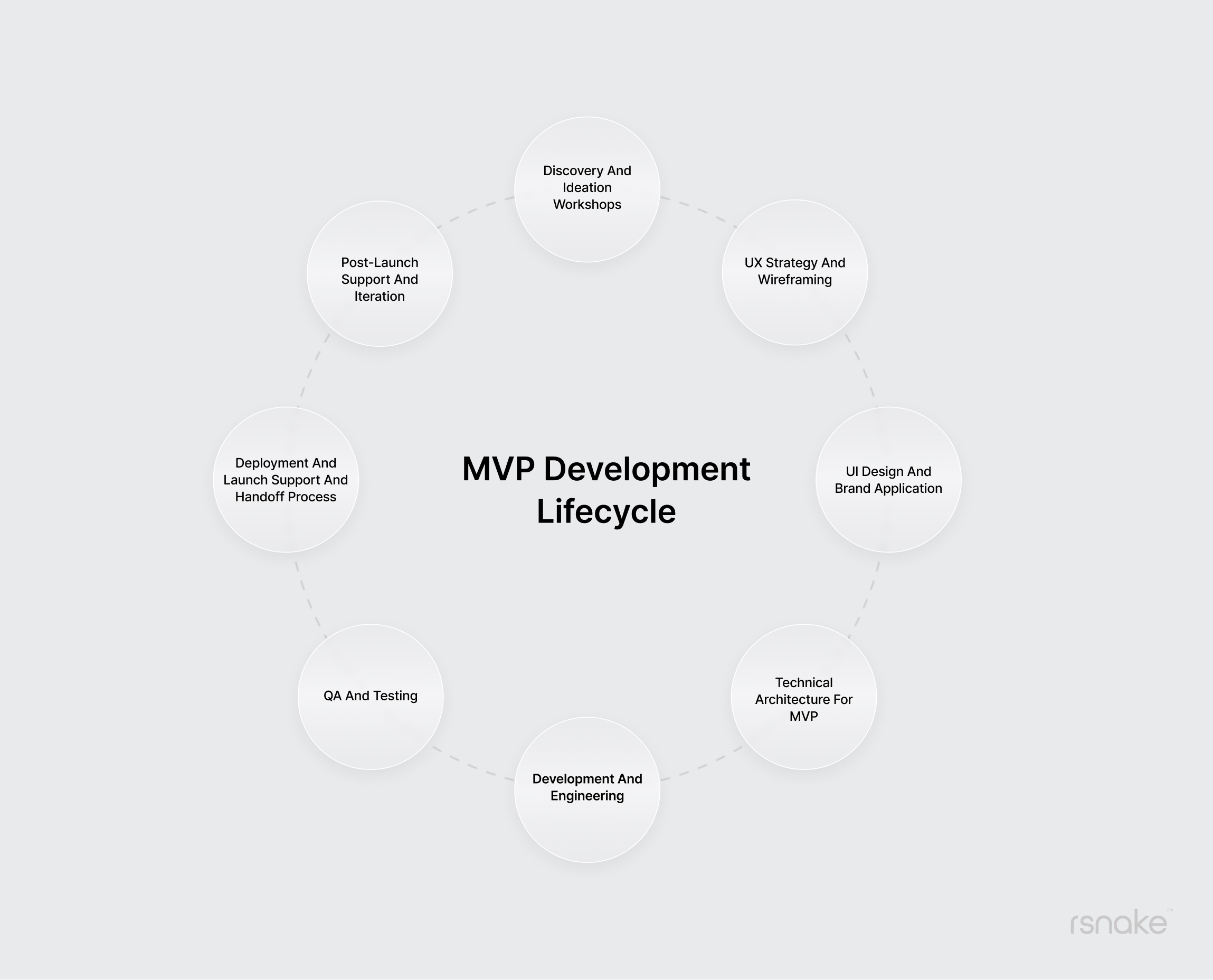
A structured MVP process matters because it gives startups a clear, step-by-step path from idea to launch, ensuring every stage, from discovery to post-launch iteration, is purposeful, validated and aligned with real user needs.
Clarify Needs: What “MVP” Actually Means For You
Before choosing a partner, it’s critical to align on what MVP means in your context. Founders often use the same term to describe very different goals.
For some, an MVP is a fast prototype with limited functionality, built to validate an idea or demonstrate it to investors and partners. For others, it is a commercially viable product that can be monetised, scaled, and iterated on over time.
A strong agency will help you define this early. At Rattlesnake, we spend time clarifying the real objective behind the MVP, so technical and design decisions support your long-term plans rather than locking you into short-term shortcuts.
1. Discovery and Ideation Workshops
Quality MVPs start with deep product understanding, not assumptions. Discovery workshops are where this foundation is built.
- Value proposition alignment: clarifying the core problem and why the product should exist
- User segmentation: defining target personas and their jobs-to-be-done
- Market and competitor research: identifying gaps and opportunities
- Success metrics: agreeing on what “success” looks like (engagement, conversions, retention)
Deliverables: a clear product brief, prioritised feature list, and an initial roadmap that everyone aligns on.
Good agencies also bring perspective from working across different products and industries. This allows them to challenge ideas constructively and apply patterns that worked elsewhere, especially valuable if they’ve built products in adjacent markets or for UK-based users with specific behavioural expectations.
2. UX Strategy and Wireframing
Before visual design or development begins, user journeys must be thought through.
- User flows: mapping step-by-step interactions to remove friction
- Wireframes: low-fidelity layouts that visualise structure and logic
- Rapid iterations: frequent founder feedback to validate direction early
Deliverables: a complete UX map that defines how users move through the product.
Strong agencies make this process visual and transparent, often directly in Figma, so founders can see and understand how decisions are made, not just receive the final output.
3. UI Design and Brand Application
Once the structure is validated, design moves to high fidelity.
- High-fidelity screens: translating wireframes into polished interfaces
- Design systems: reusable components, typography, spacing, and colour logic
- Responsive design: optimised for desktop and mobile
Deliverables: a clickable prototype and a consistent visual identity that can scale with the product.
At Rattlesnake, founders receive the full Figma file, including UI kits and design systems, not flattened exports.
4. Technical Architecture for MVP
Technical decisions made at MVP stage have long-term consequences. It’s important to choose a partner who builds for growth, not just speed.
- Architecture planning: backend, frontend, and mobile structures designed to scale
- Technology stack choice: selecting tools that support future development
At Rattlesnake, we avoid fragile, non-scalable solutions such as Bubble.io, Lovable, and similar tools. Instead, we work with proven, scalable technologies like React.js, Node.js, React Native, and cloud platforms such as AWS or GCP. This ensures the MVP can evolve into a production-grade product without rewrites.
5. Development and Engineering
With a clear roadmap, development focuses on building only what matters.
- Feature implementation: based on agreed priorities
- Integrations: payments, CRMs, analytics, AI models where relevant
- Security baseline: authentication, data protection, compliance
- Infrastructure: CI/CD pipelines and deployment setup
Deliverables: a working MVP deployed to a staging environment.
Importantly, the agency should take full responsibility for delivery, not just supply individual developers. At Rattlesnake, we own the outcome end-to-end, from design decisions to functionality.
6. QA and Testing
Testing is not optional, even at MVP stage.
- Functional testing: ensuring features work as intended
- Regression testing: preventing new changes from breaking existing logic
- Usability testing: observing how real users interact with the product
This step protects your brand and prevents avoidable post-launch issues.
7. Deployment and Launch Support and Handoff Process
A professional handoff is a critical but often underestimated phase.
- Production readiness: configuring hosting, databases, and monitoring
- Release planning: coordinating launch activities
- Early analytics: integrating tools like Google Analytics or Mixpanel
Handoff and Ownership
After delivery, founders receive full control:
- Migration from Rattlesnake servers to the client’s infrastructure
- Full Figma files with UI/UX and design systems
- PDF usage guidelines
- Fully documented codebase in GitHub
IP rights: after each completed phase and payment, we sign a formal transfer of full intellectual property rights to the client. Founders retain complete ownership of their product.
8. Post‑Launch Support and Iteration
- Bug fixes: address issues surfaced by early adopters
- UX improvements: refine flows based on user feedback.
- Data‑driven roadmap: use metrics to prioritise features for version 2.
How do MVP Agencies Help Startups Launch Faster?
Startups gain speed not by working harder, but by working smarter, and MVP agencies create that acceleration by streamlining decisions, reducing waste and keeping teams focused on what matters most.
Lean Feature Prioritisation
Startups often delay launch by chasing perfection. Agencies encourage a “less is more” mindset: build only the features that prove the core value proposition. Techniques such as the MoSCoW method help teams decide what goes into version 1. This MVP feature prioritisation ensures that development resources focus on validation, not vanity.
Reusable Infrastructure and Components
Many agencies maintain internal libraries of common modules, auth, dashboards, and payment gateways that can be dropped into new projects. These “boilerplates” accelerate development. Rattlesnake uses open‑source frameworks and pre‑built components to deliver MVPs in weeks. Reusability reduces engineering hours and allows teams to concentrate on unique functionality.
Tight Feedback Loops
Agencies build feedback mechanisms into the process. Early prototypes are shared with founders and potential users; analytics capture real behaviour from day one. MVPs are instrumented to measure metrics such as retention, feature adoption and conversion. Continuous feedback reduces the risk of shipping a product that no one wants.
Parallel Workstreams
Traditional linear development, design first, then code, then test, extends timelines. Agencies run design, engineering and testing in parallel. Designers refine wireframes while developers build backend endpoints; QA writes test scripts while developers code. This overlap compresses the MVP development timeline dramatically, helping startups launch faster.
Founder‑Friendly Collaboration
Building an MVP is an iterative journey. Agencies communicate weekly, share sprint demos and maintain a transparent backlog. Tools such as Jira, Notion and Slack keep everyone aligned. A structured partnership ensures founders remain involved without micromanaging, and decisions are made quickly based on data and expert guidance.
MVP Development Timeline: How Long Does It Take?
There is no one‑size‑fits‑all answer, but credible ranges help founders plan. Most agencies quote timelines based on complexity:
Breaking the timeline down further shows how each phase contributes:
Complex MVPs, especially those in regulated sectors such as healthcare or fintech, may require additional time for compliance and security. Some agencies caution that enterprise‑level MVPs can take 6–12 months. When budgeting time, factor in project complexity, team experience and the availability of pre‑built components.
What Determines MVP Costs?
While many agencies quote a price range, cost depends on several factors. A high‑quality MVP includes discovery, design, engineering, project management, quality assurance and DevOps. Factors that influence the budget include:
- Scope and feature set: More screens, user roles and integrations translate into more hours.
- Design depth: Custom design systems take longer than template‑based UI.
- Technical complexity: Real‑time data, AI features or advanced security require senior engineering talent.
- Team location and experience: Local talent in London comes with higher salaries and overheads; hybrid models balance cost and expertise.
- Regulatory compliance: Fintech and healthcare projects must meet stringent regulations.
Instead of quoting flat fees, Rattlesnake presents a clear breakdown of deliverables and milestones. They believe transparency around scope, timeline and dependencies is essential for long‑term partnerships.
What to Look for in an MVP Partner?
Choosing the right partner is about more than price. A reputable agency should offer:
- Clear product definition: Identify the problem, target audience and value proposition.
- Designed for learning: Embed analytics and instrumentation from day one. An MVP should answer specific questions: Will users pay? Does feature X drive engagement? Rather than just exist.
- Scalable architecture: Even lean products should use modular services and cloud infrastructure for growth.
- Documentation and handover: Provide technical documentation, design assets and API references so that your team can build on the codebase.
- Post‑launch roadmap planning: Use data to identify the next features and allocate budget wisely.
Rattlesnake adds a boutique touch. Founders stay involved, giving you direct access to strategic thinking. Communication is streamlined through Slack channels, weekly sprints and milestone meetings in their London office. The team hands over the full Figma file and design system, fully documented code in GitHub, and signs IP‑rights transfer documents after each phase. Their philosophy: product success comes from a blend of design, development and marketing, not code alone.
Common Mistakes Startups Make with MVPs and How Agencies Prevent Them
- Overbuilding: Founders often add features that dilute the core value proposition. Agencies enforce scope discipline and help prioritise features that matter most.
- Skipping discovery: Forgoing market research leads to misaligned products. Structured discovery sessions validate assumptions early.
- No market validation: Launching without user feedback wastes time and money. MVPs should collect data immediately through analytics and user interviews.
- Ignoring UX: Poor user experience drives abandonment. Agencies invest in UX strategy and wireframing before writing code.
- No analytics: Without instrumentation, you cannot learn. High‑quality MVPs include dashboards and metrics from day one.
- Poor scope control: Indecision and scope creep delay launches. Experienced agencies use feature prioritisation frameworks to keep projects focused.
- Lack of post‑launch iteration plan: The MVP is a starting point, not the finish line. A roadmap for V2 and V3 ensures continued product‑market fit.
Final Thoughts
A Minimum Viable Product is the fastest way to validate your idea and raise the funds needed to scale. Working with an MVP development agency lets you tap into cross‑functional expertise, accelerate delivery and reduce risk. Rattlesnake Group stands out as a London‑based, founder‑led boutique studio. The partners are entrepreneurs themselves, intimately involved in every project.
They pair deep technical expertise with design flair and market insight, creating products that attract investors and delight users. When selecting a partner, look beyond cost; choose a team that understands your vision, communicates openly and designs for growth. With the right guidance, an MVP becomes more than a launchpad, it’s the foundation for a sustainable, scalable business.
Note: MVP prices, timelines and cost ranges vary widely across the UK and globally. The figures shared here are industry benchmarks and real-world examples meant to inform founders, not fixed quotes. Every project differs based on scope, design depth, technical complexity, compliance requirements and the team you choose to work with.
Mikael is the Managing Partner at Rattlesnake. With a background in strategy and consulting, he oversees the company's strategic direction, leads key client partnerships, and drives growth through high-impact collaborations.


Ready to start?
Send us an email with your project details, and our team will connect with you within 24 hours to schedule a call.


© 2020-2026 Rattlesnake Group Limited.
Rattlesnake Group Limited is a limited liability company registered in England and Wales. Registered number: 12551349. Registered address: 124 City Road, London EC1V 2NX. VAT Registration Number: 436362592.


