.svg)
Go-To-Market Strategy: A Practical Framework For Launching, Scaling, And Winning Early Revenue

- A go‑to‑market strategy is a testable operating model that aligns product, marketing and sales to deliver a product to the right people at the right time. It’s more than a marketing plan and should produce repeatable revenue signals.
- To build an effective GTM strategy, define a narrow ideal customer profile, craft a clear value proposition, pick one acquisition channel to prove, decide on your pricing and sales motion, and set up metrics and feedback loops to learn quickly.
- A GTM plan differs for B2B and B2C launches: B2B focuses on multi‑stakeholder buying journeys, longer cycles and continuous value, while B2C emphasises emotional connection, simple pricing and rapid activation.
Launching a product is exciting. It is also risky. Many teams build something strong, then struggle to get traction. Not because the product is bad, but because the go-to-market strategy is unclear. A solid go-to-market strategy defines who you serve, what problem you solve, how you reach customers and how you turn interest into revenue. It connects product, marketing and sales into one focused system. Without it, launches rely on guesswork. With it, decisions become measurable. In this guide, we break down what a go-to-market strategy really means and how to build one that works.
This guide explains what a GTM strategy is, how it differs from a GTM plan and launch plan, why many strategies fail and how to build one that works. You’ll also see differences between B2B and B2C GTM strategies, examples, key metrics to track, and a template you can adapt.
What is a go-to-market strategy?
A go‑to‑market strategy is a blueprint for how a business will reach its target customers, articulate value and convert interest into revenue. It’s not a one‑off marketing campaign or a slide deck, it’s an operating model that aligns teams around who you serve, what you offer, how you price it and how you’ll learn from the market.
Definition
A go‑to‑market (GTM) strategy is a detailed roadmap for delivering a product or service to the market. a GTM strategy as a roadmap that outlines how a company will launch a product or service to new or existing markets and emphasises aligning development, pricing, sales, distribution and support to set the stage for market penetration. CGTM strategy involves understanding customers and competitors, clarifying goals and processes, and choosing pricing and channels. A good GTM strategy acts as a blueprint for conceptualising a product, targeting the right audience, crafting messaging, setting price tiers, creating a feasible timeline and keeping departments in sync.
In essence, a GTM strategy:
- Identifies the ideal customer and the “job” your product helps them achieve.
- Articulates value through a compelling proposition and positioning.
- Selects channels for acquisition and distribution.
- Determines pricing and packaging to match perceived value and willingness to pay.
- Chooses the sales motion (product‑led, sales‑led or hybrid) and supporting enablement.
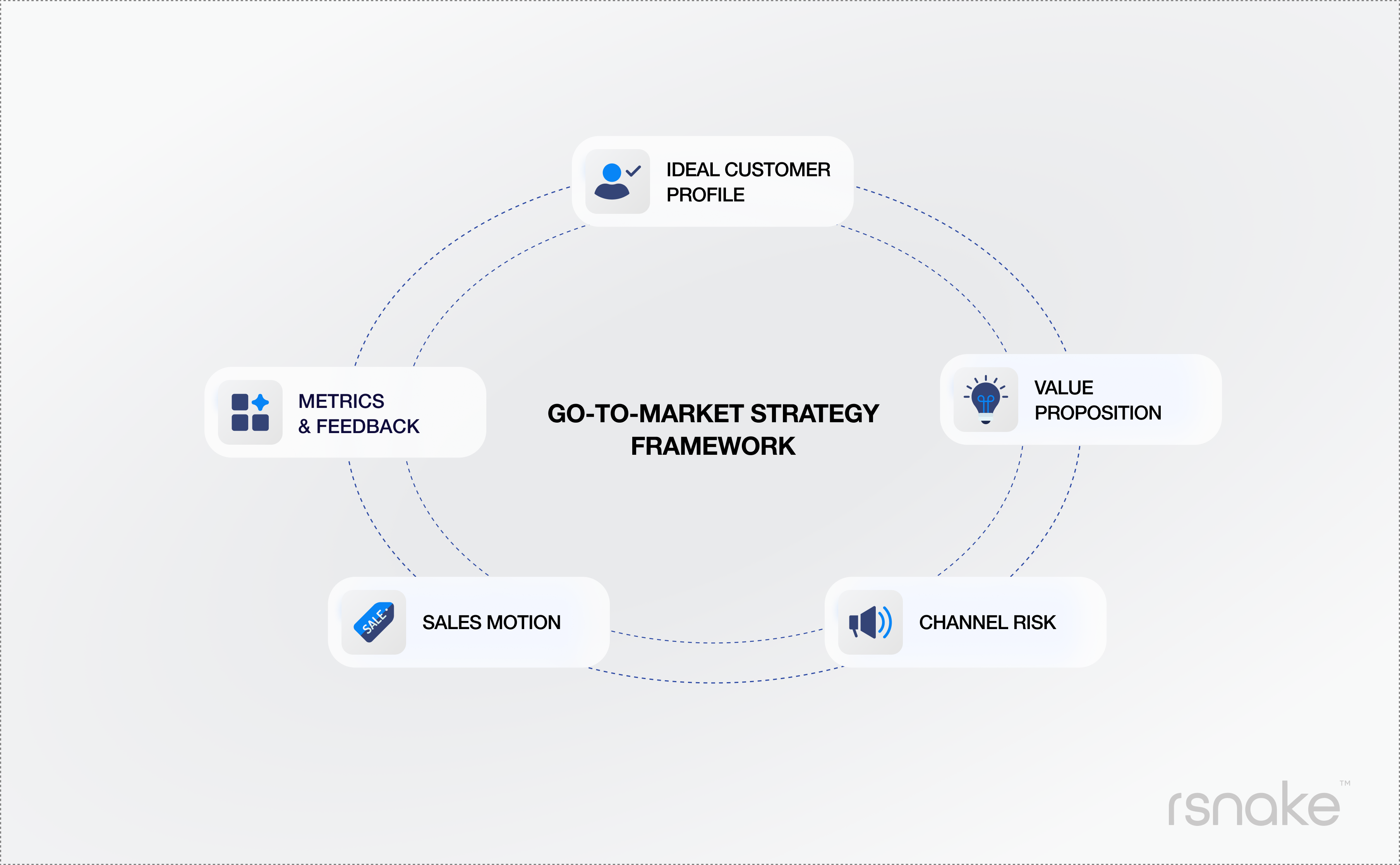
- Establishes metrics and feedback loops to measure success and iterate quickly.
What isn’t a GTM strategy?
It’s important to distinguish a GTM strategy from related concepts:
- A marketing plan is a subset of GTM that focuses on messaging, branding, content and lead generation. A GTM strategy encompasses pricing, sales, support and customer success in addition to marketing.
- A business plan covers the overall strategy of a company, including finance, operations and long‑term vision. A GTM strategy is product or initiative-specific and focuses on getting a particular offer to market.
- A launch plan is the short‑term campaign schedule for a product release. It includes tasks, owners and deadlines. It sits under the GTM plan.
Understanding these distinctions prevents confusion and ensures your team builds the right kind of plan.
Difference between GTM strategy, GTM plan and launch plan
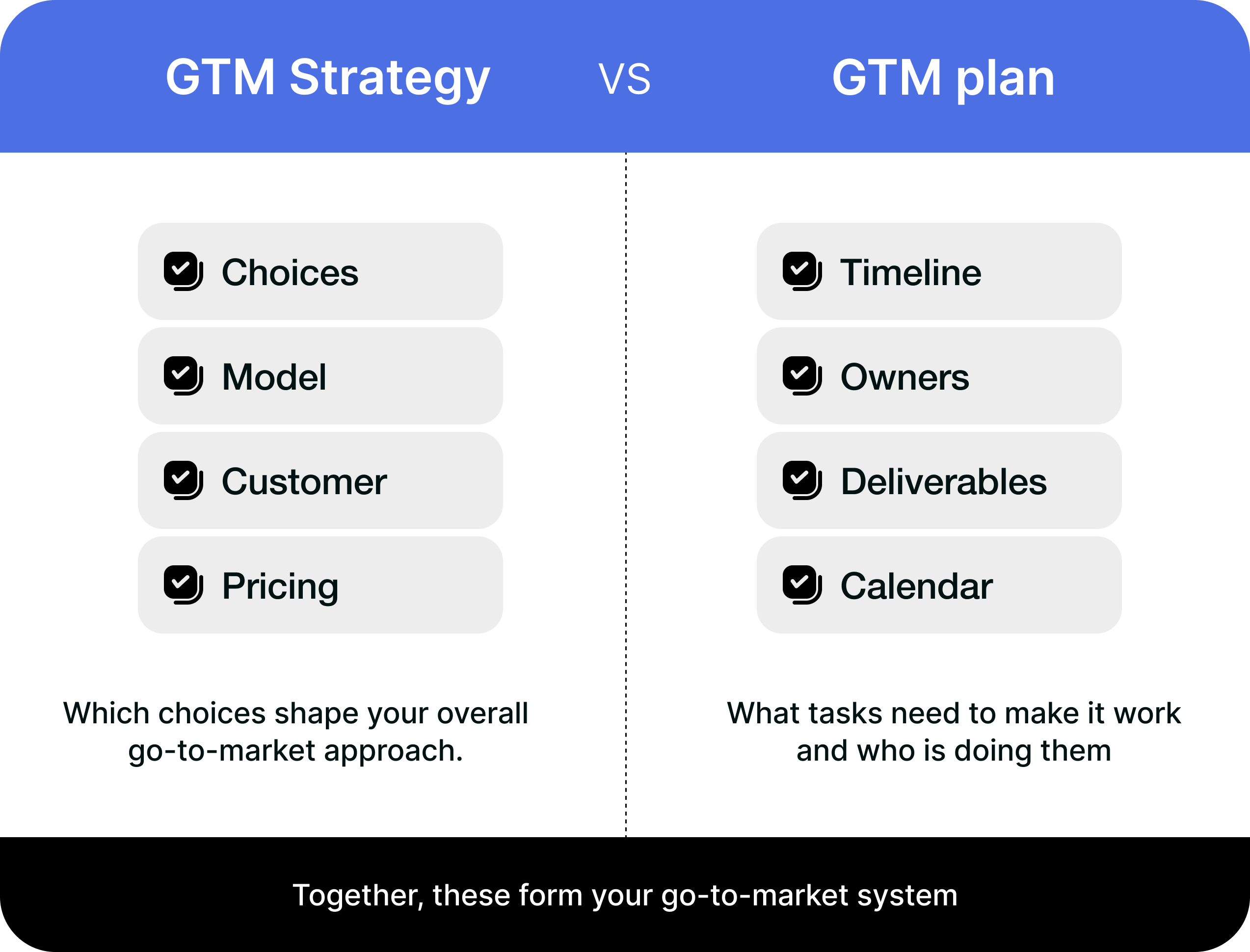
GTM stands for “go‑to‑market” - the deliberate set of choices a company makes about who to target, how to position and deliver value, and how to convert interest into revenue. A GTM plan is the tactical calendar of actions and owners that delivers on the strategy, while a launch plan is the short‑term campaign executed within the broader GTM plan.
GTM strategy vs GTM plan
- GTM strategy: The high‑level operating model. It defines who you’re targeting, what value you deliver, how you price and sell, and how you’ll measure success. It answers the “why” and “what.”
- GTM plan: The actionable schedule. It assigns owners, sets deadlines and details the steps needed to implement the strategy. It answers the “how,” “when,” and “who.”
GTM plan vs launch plan
- GTM plan: Covers pre‑launch, launch and post‑launch activities, including product readiness, marketing, sales enablement and customer success. It may span months or quarters.
- Launch plan: A subset of the GTM plan that focuses on the critical few weeks when the product goes live. It includes campaign channels, content rollout, outreach and initial feedback activities.
Why go‑to‑market strategies fail in the real world?
Most GTM strategies fail because they are either too broad or not grounded in measurable customer pain. Without a clear ICP, focused messaging and aligned channels and pricing, teams spin their wheels and burn resources.
Common pitfalls include:
- Overly broad ideal customer profile (ICP). When the ICP isn’t narrow, messaging becomes generic, and channels become diluted. Strong GTM strategies align sales, marketing and enablement around a well‑defined audience. Skipping this step leads to missed alignment.
- Messaging not anchored to a specific pain. Without a value matrix that maps buyer problems to product benefits, marketing campaigns and sales pitches lack resonance.
- Channel mismatch. Choosing channels that your ICP doesn’t use, or splitting resources across too many channels, leads to wasted budget.
- Pricing disconnected from value. Without understanding how your buyer perceives value and what alternatives cost, pricing becomes guesswork. It’s important to define your pricing strategy around customer preferences and business objectives.
- Sales motion is misaligned with the buying process. A product‑led approach works for self‑service SaaS; a sales‑led approach is better for complex enterprise products. Mixing motions confuses buyers and internal teams.
- No instrumentation or feedback loop. Highspot stresses tracking customer engagement rates, sales process velocity and customer lifetime value to correlate buyer behaviours with revenue outcomes. Without clear metrics and regular reviews, teams can’t learn and iterate.
The core components of a go‑to‑market strategy
Successful GTM strategies cover more than marketing. They span market context, customer definition, value, positioning, channels, pricing, sales motion, demand generation, and metrics. Each component links to the next, creating a cohesive operating model.
1. Market context
Begin with a light but rigorous analysis of the market and competitive landscape. Understanding competitors and customer needs reduces the risk of poor sales and high costs. Market research at this stage identifies trends, barriers, and adjacent opportunities.
2. Ideal Customer Profile (ICP) and buying committee
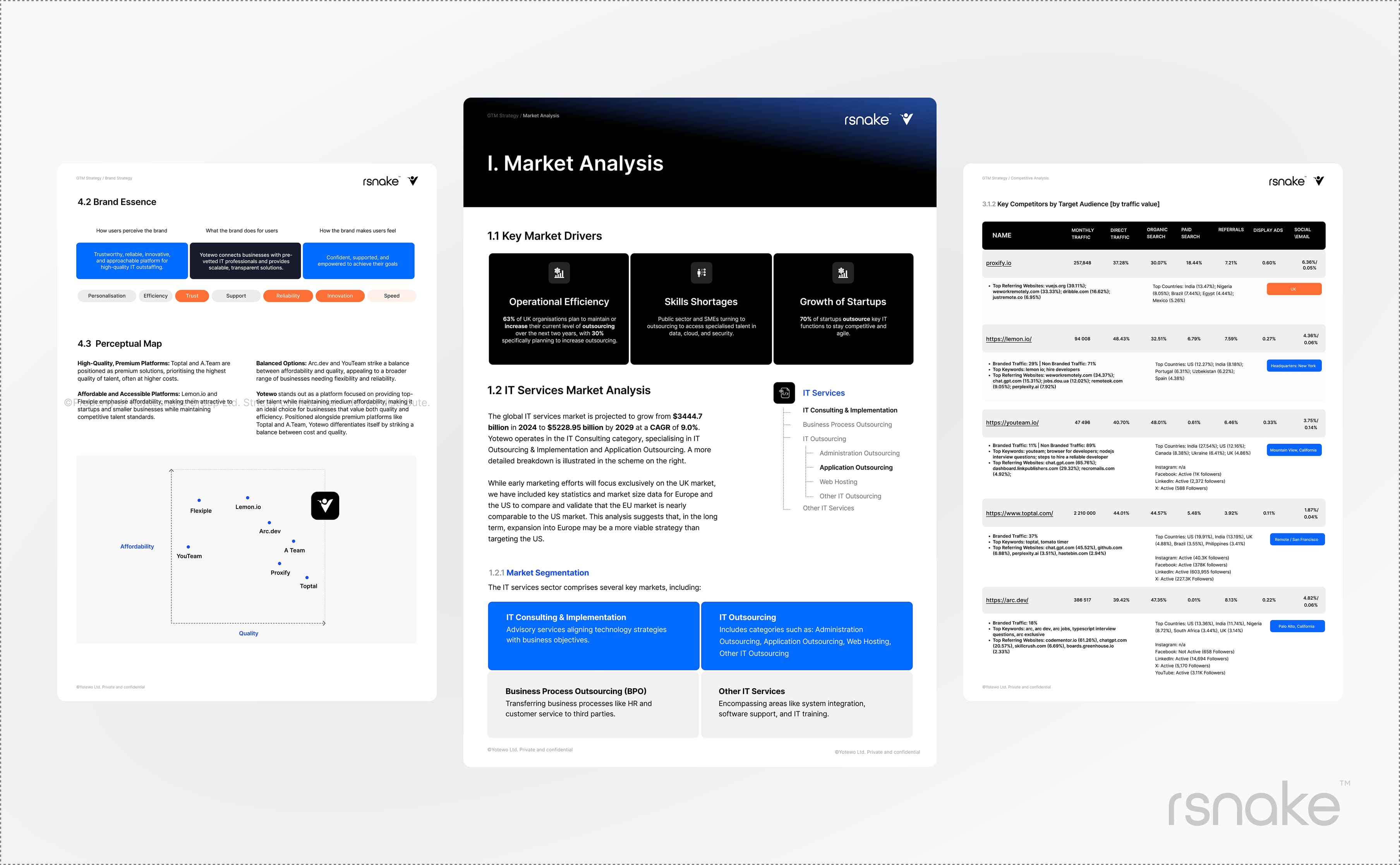
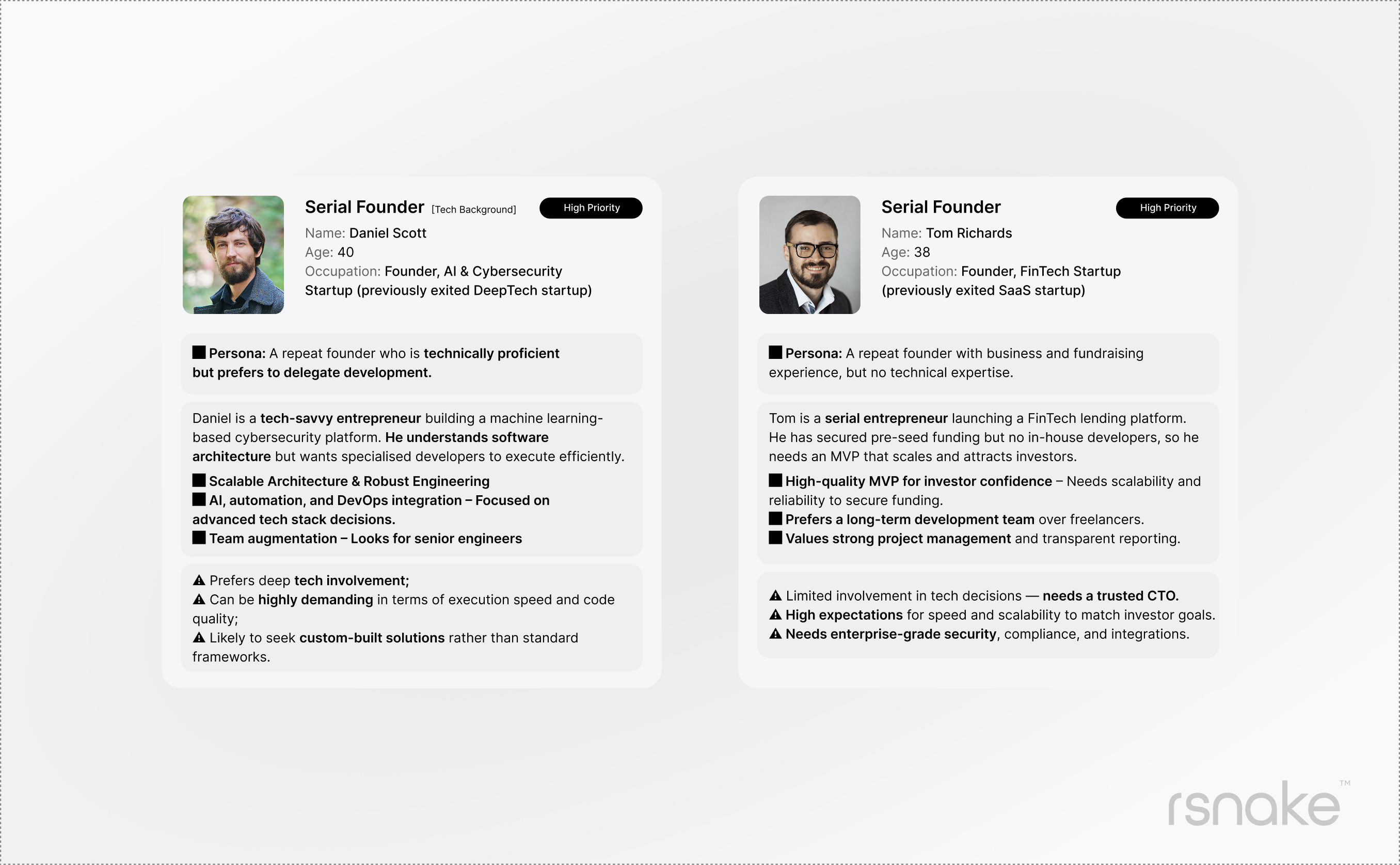
Define the specific buyers (or buying committees) most likely to purchase. For B2B, this includes roles (e.g., decision maker, influencer and user) and attributes like company size, industry and budget. For B2C, define demographic and psychographic traits. Rattlesnake’s startup guide emphasises defining the user, the job and the outcome in a single sentence.
3. Value proposition and proof
Articulate how your product solves the customer’s job better than alternatives. Value proposition benefits the product provides and the problem it solves. Provide evidence: testimonials, case studies, demos or data points.
4. Positioning and category narrative
Positioning distinguishes you from competitors. It tells customers who you are, what you do and why you’re different. A category narrative frames the market in a way that makes your solution the obvious choice.
5. Channel strategy
Choose primary acquisition channels based on where your ICP spends time. Channels could include search, content marketing, communities, events, partners or direct sales. For early testing, focus on one channel to prove traction before expanding.
6. Pricing and packaging
Select a pricing model (subscription, one‑off, freemium, tiered) and price points that align with value and willingness to pay. Consider packaging features into tiers to capture different segments. The value metric (e.g., seats, usage, revenue) should correlate with customer outcomes.
7. Sales motion and enablement
Decide on your sales motion: Product‑led growth (PLG) emphasises self‑service trials and upgrades; Sales‑led growth (SLG) involves reps guiding the buyer through a complex purchase; Hybrid combines the two. Sales enablement provides materials, training and processes so sales teams can execute the motion effectively.
8. Demand strategy
Outline how marketing will generate awareness and demand. This includes content marketing, paid media, community engagement, webinars and partnerships. Align campaigns with the ICP’s buyer journey stages: awareness, consideration, decision and retention.
9. Metrics and feedback loop
Identify metrics that signal traction. It’s advisable to track customer engagement rates, sales process velocity, customer lifetime value, pipeline coverage and initiative adoption. Create a feedback loop with regular cadence to adjust the strategy based on data.

How to create a go‑to‑market strategy (step‑by‑step)
The strongest GTM strategies start with the customer and value, then build out channels, pricing, sales motion and measurement. Focus on the narrowest hypothesis that can prove or disprove your model, and iterate quickly.
Step 1: Define your ICP and the job you win
Rattlesnake’s market research framework recommends starting with the problem, not the product: write one sentence that names the user, the job and the outcome. Sketch your initial segments by role, company size, industry and context, and note assumptions about willingness to pay and adoption triggers. Clarify the “kill list” criteria that would make you stop or pivot.
Step 2: Map buyer pain to product value
Create a value matrix that lists customer pains, the product features that address them and proof points. This ensures messaging and sales conversations are anchored to measurable pain rather than generic benefits.
Step 3: Choose one primary acquisition channel
Testing too many channels at once can confuse results. Pick the channel where your ICP already gathers, such as SEO, paid search, communities or direct outreach. Prove traction before expanding.
Step 4: Set pricing around a value metric
Select a pricing model and value metric that reflect how customers derive value. Pricing should balance business objectives, customer profile and competitive landscape.
Step 5: Decide the sales motion
Evaluate whether your product is best delivered via self‑service (PLG), high‑touch sales (SLG) or a hybrid model. Consider complexity, deal size and customer preference. Equip teams with enablement materials: demo scripts, objection handling guides and competitive battle cards.
Step 6: Build your GTM plan
Translate the strategy into an actionable plan. Define owners, timelines, deliverables and dependencies. Include a cross‑functional RACI (responsible, accountable, consulted, informed) chart to clarify accountability.
Step 7: Launch with measurement and learning cadence
Launch your product to a limited audience first (a “beta”) to validate assumptions. Rattlesnake’s MVP process recommends selecting a small group of early adopters for feedback before a full launch. Instrument your product with analytics to monitor user behaviour and KPIs at launch. Schedule weekly or biweekly reviews to capture insights and iterate.
Go‑to‑market strategy vs marketing strategy vs business plan
A GTM strategy orchestrates development, pricing, sales, support and marketing to launch a product successfully. A marketing strategy is a subset that focuses on awareness and demand. A business plan is broader and may include financial projections, operations and long‑term vision.
Summary of the differences is: a go‑to‑market strategy establishes product‑market fit, pricing, sales channels and support; a marketing strategy raises brand awareness and generates interest; and a business plan covers the entire company.
B2B vs B2C go‑to‑market strategy
While both B2B and B2C GTM strategies aim to introduce a product to its target audience, they differ in buying cycles, decision processes, messaging tone and proof. B2B strategies prioritise long‑term relationships and ROI, whereas B2C strategies emphasise emotional connection and rapid activation.
B2B GTM strategy
- Longer sales cycles and multi‑stakeholder decisions: B2B deals involve multiple stakeholders and thorough scrutiny. The sales process is longer and requires nurturing leads through several stages.
- Prioritising ROI and lifetime value: B2B marketing focuses on return on investment and long‑term customer relationships. Products are often subscription-based and require continuous value delivery.
- Complex pricing and negotiations: Deals are often customised and involve contracts that span months or years.
- Educational content and proof: B2B buyers expect detailed content that educates them and provides case studies, ROI calculators and product demos.
B2C GTM strategy
- Shorter, impulse‑driven purchase cycles: B2C customers make faster decisions and often respond to emotional triggers. The focus is on capturing attention and encouraging quick conversions.
- Self‑service models: Traditional sales calls are less effective; customers prefer to research and buy on their own.
- Clear, simple messaging: B2C communication should avoid jargon and speak in an accessible and engaging way.
- Volume over depth: B2C marketing aims to reach large audiences through broad channels (social media, paid ads). Pricing is usually fixed and transparent.
Go‑to‑market strategy examples (three scenarios)
The principles of GTM strategy apply across sectors, but the execution differs. Here are three illustrative scenarios that map the ICP, channel, sales motion, pricing and KPIs.
1. B2B SaaS entering a vertical
A SaaS company offering a project management tool wants to sell into the construction industry.
- ICP: Mid‑sized construction firms (50–200 employees) with dedicated project managers.
- Value proposition: Consolidate schedules, budgets and subcontractor coordination in one platform, reducing project overruns.
- Channel: Direct outbound, complemented by webinars hosted in partnership with construction associations.
- Sales motion: Sales‑led with demos, pilots and procurement approvals; pricing per active project.
- KPIs: Pipeline creation, demo‑to‑deal conversion rate, sales cycle length, activation rate.
2. Consumer app launching a new premium tier
A meditation app releases a premium subscription with advanced content and personalised coaching.
- ICP: Existing free users aged 25–40 who meditate at least twice per week.
- Value proposition: Deeper, personalised practice with exclusive sessions and one‑on‑one coaching.
- Channel: In‑app prompts, email campaigns and influencer partnerships.
- Sales motion: Product‑led: free trial of premium tier, upsell within the app.
- Pricing: Monthly subscription with annual discount; value metric is access to exclusive content.
- KPIs: Trial conversion rate, churn rate, average revenue per user (ARPU), and user engagement.
3. Services firm productising an offer
A design agency packages its design and development process as a “sprint” for early‑stage startups.
- ICP: Seed‑stage startups without an internal design team.
- Value proposition: End‑to‑end sprint delivering a validated prototype, MVP roadmap and investor‑ready collateral.
- Channel: Content marketing (guides, webinars), founder networks and accelerators.
- Sales motion: Hybrid: inbound leads self‑book discovery calls; agency founder participates in the sales call.
- Pricing: Fixed package price with optional add‑ons; payment milestone at kick‑off and delivery.
- KPIs: Lead volume, discovery‑to‑deal conversion rate, customer satisfaction, referral rate.
GTM metrics and KPIs (what to track in the first 90 days)
Measuring progress early and often is the only way to validate your GTM strategy and adjust. Focus on leading indicators that reveal whether you are on track before revenue is obvious.
It’s recommended to track customer engagement rates, sales process velocity, and customer lifetime value alongside pipeline coverage, rep attainment, and initiative adoption. Here’s a breakdown of key metrics for your first 90 days:
The GTM plan template
While every product is different, a structured template accelerates planning and ensures nothing falls through the cracks. Use this template as a starting point and customise it for your context.
Inputs
- Product overview: What you’re launching, the problem it solves, and the competitive landscape.
- Ideal customer: Segment, persona, pain points and goals.
- Value proposition: The outcomes you deliver and proof points.
- Primary channel: Where you will reach your ICP initially.
- Pricing & packaging: Your pricing model and tiers.
- Sales motion: PLG, SLG or hybrid; key enablement assets.
Roles and ownership
- Product owner: Owns the product roadmap and ensures readiness.
- Marketing lead: Crafts messaging, content and demand generation.
- Sales lead: Oversees pipeline generation and closing motions.
- Customer success lead: Manages onboarding and retention.
- Executive sponsor: Provides alignment and resources.
Weekly review cadence
Establish a weekly meeting with leaders from product, marketing, sales and customer success. Review metrics, share insights and adjust tactics. Quarterly reviews led by revenue operations are recommended to recalibrate the strategy; weekly cadences keep teams aligned.
Risk list and mitigations
- Market risk: The problem isn’t painful enough → mitigate by validating early with interviews and surveys.
- Channel risk: The chosen channel doesn’t reach the ICP → mitigate by running small experiments across 2–3 channels and concentrating budget where metrics outperform.
- Pricing risk: Customers reject the price → mitigate through willingness‑to‑pay surveys and competitive analysis.
- Sales motion risk: Sales process mismatched → mitigate by testing multiple motions (self‑service vs high touch) with clear criteria for success.
Bringing it all together: operationalising your GTM strategy
A go‑to‑market strategy is only useful if it produces repeatable revenue signals. That requires execution discipline. Rattlesnake Group believes that commercially viable products emerge at the intersection of these skills; technical prowess alone isn’t enough. Boutique model ensures founders remain personally involved throughout each project, maintaining direct communication and attention.
By partnering with a team that owns the entire lifecycle from research to go‑to‑market, founders can focus on winning early revenue while ensuring their product is built on solid, scalable foundations.
Book a call with Rattlesnake to align design, development and go-to-market into one focused execution plan.
Mikael is the Managing Partner at Rattlesnake. With a background in strategy and consulting, he oversees the company's strategic direction, leads key client partnerships, and drives growth through high-impact collaborations.


Ready to start?
Send us an email with your project details, and our team will connect with you within 24 hours to schedule a call.


© 2020-2026 Rattlesnake Group Limited.
Rattlesnake Group Limited is a limited liability company registered in England and Wales. Registered number: 12551349. Registered address: 124 City Road, London EC1V 2NX. VAT Registration Number: 436362592.


