
From MVP to Product-Market Fit: The Engineering Decisions That Matter

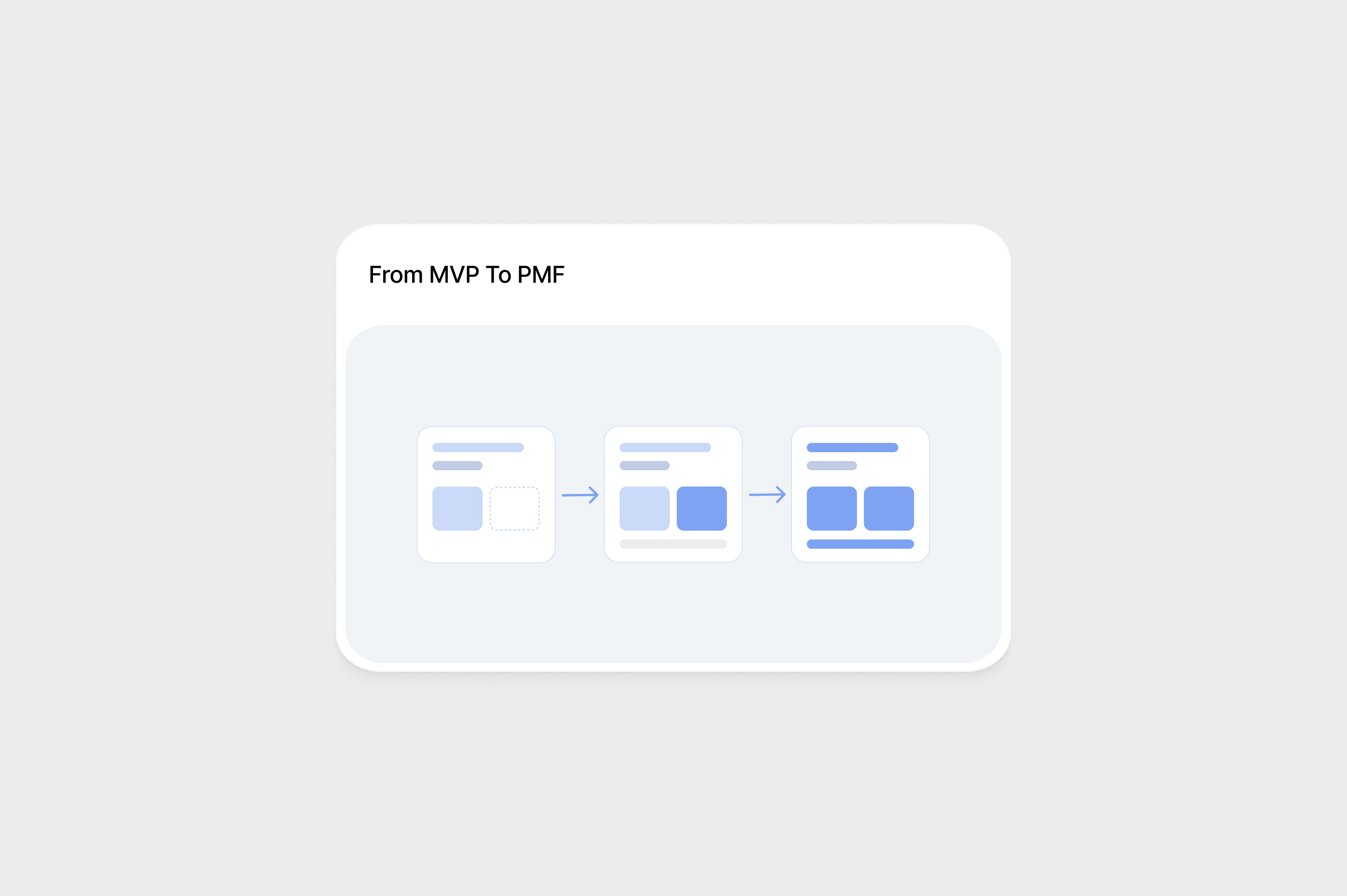
- Instrument the core value journey, not every click. Track activation, time to first value and user retention by segment.
- Fix defects that block value or corrupt product analytics. Defer polish and capacity work with no current demand.
- Keep architecture and releases easy to change. Scale only after retained customers and real load expose a limit.
Launching an MVP is not the finish line. It is the point where learning begins. A minimum viable product can show that users complete a core task. It cannot prove product-market fit. That evidence comes from repeat use, paid commitment, referrals and customer conversations.
The engineering work after launch shapes how a team can read those signals. Track the core value journey. Fix failures that block it. Keep releases small and architecture easy to change. Do not spend time on capacity for users you do not yet have. Build reliability to trust the data; let evidence set the next priority.
MVP, product-market fit, and scale are different stages
Before we define MVP, clear up one common error. MVP means minimum viable product, not “MVP most viable product”. It is a deliberately limited product that tests important assumptions with real users. If someone asks “what is an MVP product?”, that is the short answer.
A product MVP launch proves neither fit nor scale. Early revenue, downloads and praise can be useful signals. None proves repeatable demand alone.
The market for a product matters, but it is not a synonym for product-market fit. SVPG calls market fit repeatable “market pull” under real budget and market pressure. Read SVPG’s first-party explanation of market fit.
How to find product-market fit after the MVP launch?
Before launch, teams ask whether users can complete the main journey. Post-launch product development asks sharper questions:
- Which segment reaches the activation event?
- How long does first value take?
- Which users return at the product’s natural frequency?
- Where do committed users fail, leave or ask for help?
- Which behaviours correlate with user retention?
- Which small product iteration changes those behaviours?
The roadmap now becomes a list of testable hypotheses. It stops being a promise to complete an old specification. This shift sits at the centre of moving from MVP to product-market fit.
Product-market fit remains a product and market question. Engineering supports the search, but code cannot manufacture demand. Use activation, cohort retention, conversion, churn, expansion and referrals together. Speak with customers too. Never blend these signals into one universal score.
Natural usage frequency changes the reading. A payroll tool, travel service and daily team app need different windows.
Engineering decision 1: instrument the core value journey
Recommendation: define one core value event, then trace the path to it. A login is an activity. It rarely proves delivered value.
For a reporting tool, define activation as connecting a data source and sharing a completed report. For a payments product, use a settled transaction. Record signup, onboarding steps, the activation event, time to first value, repeat value events, conversion, failures and abandonment.
Write an event taxonomy. Use names based on user actions and stable properties. Test every event in QA. Segment results by customer type and acquisition source. Product analytics with broken names, missing events or duplicate users creates confident but false stories.
Collect data for a stated decision. The ICO says PECR covers cookies, pixels, scripts, tags and related storage or access methods. UK GDPR applies where personal data is involved. Review the ICO guidance on storage and access technologies before releasing analytics.
Engineering decision 2: fix reliability faults that corrupt learning
Recommendation: repair faults in the core journey ahead of the next experiment. A failed email, timeout or webhook can look like weak demand.
Prioritise data loss, permission faults, payment failures, broken integrations and missing error reporting. Add tested backups and a practical recovery path. Do not wait for a bug-free product. Make the core journey reliable enough to read user behaviour fairly.
Engineering decision 3: keep architecture simple and changeable
Recommendation: use the fewest operational parts that support safe releases. Rattlesnake’s published MVP architecture starts with a modular monolith and one relational database for many early products. See its guide on how to build an MVP.
A simple base can include clear module boundaries, managed infrastructure, automated deployment, access controls, basic observability and a documented data model. Simple does not mean tangled or undocumented.
Delay microservices and multi-region infrastructure until evidence calls for them. Google Cloud notes that distributed services need extra patterns for observability, retries and data consistency. Its microservices architecture guide explains that added complexity.
Change architecture after a proven trigger. Examples include distinct workload needs, repeated release conflicts, required failure isolation, a blocking data model, regulatory separation or rising operational cost.
Engineering decision 4: create a fast, safe release loop
Recommendation: ship the smallest useful change tied to a hypothesis. Product iteration needs a short feedback cycle, not a stream of unrelated features.
- State the user problem.
- Predict the behavioural change.
- Set one success measure and guardrails.
- Release a small change.
- Observe behaviour and faults.
- Interview affected users.
- Keep, amend or reverse the change.
- Record what the team learnt.
Support that loop with version control, code review, critical-path tests, preview environments, error tracking and rollback. DORA’s 2023 study linked faster code reviews with 50% higher software delivery performance. It linked user-focused teams with 40% higher organisational performance. These are associations across its survey, not guarantees for one startup. Read the official DORA 2023 findings.
Release frequency matters only when each release tests a useful idea.
Engineering decision 5: pay down technical debt that slows learning
Recommendation: classify technical debt by its effect on the next stage. Do not launch a rewrite to satisfy an engineering preference.
Ask one question: will this work improve learning speed, reliability, security or service for retained customers during the next phase? If the answer is no, place it in a dated debt register. Revisit it after new evidence arrives.
This test keeps product development focused. It can support a rebuild, but only where the current code blocks safe change or proven demand.
Engineering decision 6: separate retention work from feature requests
Recommendation: treat each request as evidence of a problem, not an approved specification. One export request can signal poor reporting, low trust or a missing integration.
Rank requests by frequency among retained users, connection to core value, effect on activation or churn, and fit across the target segment. Add build and maintenance cost. Test demand manually where possible.
This filter protects user retention from a crowded roadmap. It keeps the MVP product narrow enough to learn. It gives product development and engineering teams a shared reason for each choice.
Engineering decision 7: prepare for scale after a measured trigger
Recommendation: scale proven constraints, not imagined traffic. Strong user retention in one segment, repeat referrals and predictable usage support further investment. Actual load must expose the engineering limit.
Useful triggers include slowing high-value actions, repeat incidents, rising infrastructure cost, release bottlenecks or recurring enterprise controls. Weak triggers include hypothetical global demand, every requested integration and a large redesign with no measured usability problem.
This is how to get product-market fit without spending runway on unused capacity. It is how to find product-market fit through evidence, then build for demand you can see.
The engineering feedback loop from MVP to product-market fit

How to tell whether engineering is helping
Read the measures together with interviews, sales evidence and support records. Product analytics shows what happened. Customer research helps explain why.
From MVP to product-market fit: choose evidence over volume
The move from MVP to product-market fit is not a race towards more features. It is a search for repeatable customer value. Sound engineering decisions make the search faster through clear measurement, reliable journeys and low-cost change.
Rattlesnake reports more than five years of work and over 80 delivered digital products. Its MVP development company supports launch and validation. Its product-led software development service covers post-launch product development. Request a product and engineering review to turn current evidence into a focused roadmap.
Rattlesnake is a leading product design and development studio based in London. We partner with ambitious companies to build digital products, brands, and growth systems that perform.


Ready to start?
Send us an email with your project details, and our team will connect with you within 24 hours to schedule a call.


© 2020-2026 Rattlesnake Group Limited.
Rattlesnake Group Limited is a limited liability company registered in England and Wales. Registered number: 12551349. Registered address: 124 City Road, London EC1V 2NX. VAT Registration Number: 436362592.


