.svg)
AI SEO Services for SaaS Companies: What to Look For and What to Avoid


- SaaS SEO is not the same as e‑commerce or media SEO. It plays out over months, involves committees, and depends on high‑intent queries and bottom‑of‑funnel pages. The right partner focuses on the pipeline, not just traffic.
- AI is reshaping online discovery. In one Harvard Business Review case study, Google AI Overviews appeared for 78% of a company's core product queries, highlighting the growing need to optimise for both search engines and AI-generated answers.
- The best SaaS SEO agencies work like product teams. They audit technical foundations, build topical authority, design high‑converting comparison and pricing pages, and measure success in trials and revenue, not sessions. They integrate AI tools and design systems, and act as strategic partners for the long haul.
Search engine optimisation for SaaS is about earning trust before a trial ever begins. Buyers research, compare and evaluate for weeks or months. They rarely convert on a first click; instead, they move through awareness, consideration and decision stages across multiple touchpoints.
A SaaS SEO agency that treats B2B software like an e‑commerce store will deliver traffic, but not pipeline. Modern SEO services for saas must align with longer buying cycles, high‑intent keywords, and technical performance that supports sign‑ups. The rise of AI‑driven search adds another layer: your brand must show up in AI overviews and answer engines, not just blue links.
This guide explains why SaaS SEO is different, how AI is reshaping it, what best‑in‑class services look like in 2026, how to evaluate SaaS SEO agencies, and what a 90‑day engagement feels like.
Why SaaS SEO is different: and harder than most agencies admit
SaaS buyers behave very differently from consumers. According to B2B research, the average sales cycle runs about two months. Multiple stakeholders, IT, finance, and operations, evaluate your product, each with different search queries and decision criteria. Search volume on individual keywords is low, but the revenue potential is high. Generic “growth hacks” won’t cut it.
Three factors make SaaS SEO distinct:
- Intent over volume. Long‑tail, high‑intent queries (“project management tool GDPR compliant pricing”) drive meaningful pipeline, whereas vanity keywords deliver little. Content must target these specific questions and guide visitors toward trials.
- Bottom‑of‑funnel strength. Pricing, comparison and alternative pages often convert best. They serve visitors who are already product‑aware and evaluating options. Many SEO consultants for SaaS companies still prioritise top‑funnel blogs and ignore these high‑value pages.
- Technical performance counts. Complex SaaS sites with dynamic dashboards, gated content and multiple subdomains can suffer crawl and indexation issues. Core Web Vitals, structured data, internal linking and clean code directly affect trial activation and user experience.
An expert SEO SaaS partner understands that a ranking without a conversion path is worthless. They design content and site architecture to move buyers smoothly from awareness to action, and they use metrics like trial sign‑ups, activation rate and pipeline-influenced revenue to measure success.
What AI search means for SaaS SEO in 2026
AI-driven search is changing how buyers discover and evaluate software. As users increasingly turn to AI-powered tools for research, traditional search journeys are becoming less predictable. Harvard Business Review highlighted one example where Google AI Overviews appeared for 78% of a company's core product queries, contributing to a significant decline in traffic to some of its highest-value pages.
For SaaS companies, this shift means visibility is no longer limited to traditional rankings. Content must be structured for both search engines and AI-generated answers. Brands that build topical authority, publish original insights, and create content that AI systems can easily understand and cite will be better positioned to capture demand across both search environments.
- Answer Engine Optimisation (AEO). Focuses on giving clear, structured answers that AI systems can quote. Pages with E‑E‑A‑T credentials, clean schema and robust backlinks are most likely to be cited. Adding the FAQ and HowTo schema has increased AI Overview impressions even when classic rankings remain unchanged.
- Generative Engine Optimisation (GEO). Makes content easy for large language models to parse and reuse. Practitioners recommend framing headings as questions, answering them directly in the first two sentences, and using short paragraphs and bullet lists. This structure enables AI to extract snippets and summarise content accurately.
Optimising for AI search doesn’t mean chasing gimmicks. It means tightening fundamentals: start each section with a 40‑ to 60‑word answer, break topics into clear H2S, include detailed FAQs, and implement rich schema for articles, FAQs and organisations.
The top answer engine optimization tools for SaaS companies now track citation frequency across ChatGPT, Perplexity and Gemini, not just ranking positions. Forward‑thinking agencies invest in the best LLM SEO agency for SaaS tactics: they use machine learning to identify content gaps, cluster intents, and automate internal linking. An effective machine learning seo agency will also leverage AI to generate edge‑case test scenarios, propose alternative architectures and accelerate code reviews, all of which Rattlesnake integrates into its AI engineering workflow.
What the best SaaS SEO agencies actually do: a breakdown of services
A high‑performing SaaS SEO agency looks less like a copy shop and more like a product‑led growth partner. Here’s what that means.
Technical SEO and site architecture
SaaS websites often include gated dashboards, dynamic URLs and separate subdomains for marketing, app and docs. These complexities create crawl and indexation challenges. The best agencies start with a comprehensive audit: they assess crawlability, Core Web Vitals, structured data, internal linking, duplicate content, and redirect patterns.
Tools like Screaming Frog, Ahrefs Site Audit and Semrush help, but expertise matters more than software. A competent team identifies what to fix first (e.g., improving load times or consolidating subdomains) and partners with developers to implement changes. Technical hygiene lays the foundation for all other SEO work.
The best SEO tool for SaaS tasks often includes site speed analysis and structured data validation. For example, Rattlesnake’s engineers follow a modular monolith architecture with adapter layers, RBAC/ACL controls and structured logging to keep MVP builds lean and scalable. This architecture reduces technical debt and supports fast, crawlable code, which is essential for search performance
Content strategy and topical authority
Ranking for a single keyword won’t build a pipeline. SaaS buyers run dozens of searches, so the content strategy must map the entire buyer journey. The most effective SEO strategies for SaaS companies focus on topical authority: owning an entire cluster of related topics so completely that search engines and AI systems treat your site as an authority. That means publishing deep, expert‑led guides, original research, calculators and interviews, and interlinking them to build a semantic network.
Rattlesnake approaches content through brand strategy first. Before writing a single article, they work with founders to define the brand’s positioning and key messages. This ensures that every piece of content reinforces the company’s narrative and serves a clear intent. It also aligns marketing with product strategy and design, a critical element for B2B success.
Bottom‑of‑funnel pages
Comparison pages (“Product X vs Product Y”), alternatives pages (“Best alternatives to X”), and pricing pages convert better than generic blog posts. Many SaaS SEO agencies underinvest here because writing these pages requires careful positioning and design. A good agency will develop honest, balanced comparison pages that help prospects understand differentiators and make informed decisions. Design and UX matter as much as copy: clear layouts, scannable tables, and call‑to‑action buttons ensure visitors convert.
How to evaluate SaaS SEO agencies: 6 criteria that matter
- Depth of understanding. The top SEO agency for SaaS doesn’t start with deliverables. They ask about your industry, ideal customer profile, competitors and churn drivers. If a proposal jumps straight to keywords and blog volume, consider it a red flag.
- Relevant case studies. Results in e‑commerce or publishing don’t transfer to SaaS. Ask for case studies showing trial sign‑ups, demos or revenue growth for similar products. The best SEO agency for saas company engagements should prove pipeline impact, not just traffic increases.
- AI search inclusion. Today’s best AI optimization SEO agencies treat AI search as part of the brief. They should speak fluently about AI Overviews, ChatGPT Search, Perplexity and answer engine optimisation. If AI is missing from their strategy, they’re behind the curve.
- Integrated design and development. SEO without design fails to convert. Look for SEO agencies for SaaS that pair writers with designers and developers. A partner like Rattlesnake offers frontend and backend development, so technical fixes and design improvements happen together.
- Reporting and attribution. Rankings and sessions don’t pay the bills. The best SEO firm for SaaS companies reports on trial sign‑ups, sales qualified leads and pipeline influenced revenue. They also track AI citation frequency and share of voice across answer engines.
- Strategic partnership over volume. Beware content mills that promise dozens of posts per month. The best agencies act as extensions of your marketing team, bring product thinking and remain flexible with scope. They care about outcomes and long‑term relationships rather than hours logged.
SaaS SEO strategy: what a 90‑day engagement looks like
A structured 90‑day plan is critical for momentum and accountability. Each month has clear objectives.
- Month 1 - Foundation. Conduct a technical audit and prioritise fixes. Map keywords and intents across the buyer journey. Perform competitor content gap analysis. Implement structured data. Establish an AI visibility baseline – where does your brand appear in AI answers?
- Month 2 - Content build. Create bottom‑of‑funnel pages first: comparison, alternative and pricing pages. Plan topical clusters and publish the first cluster. Improve internal linking. Document SEO strategies for SaaS companies aligned with your product roadmap.
- Month 3 - Authority and AI. Build off‑site signals through industry publications, directories and partner mentions. Begin tracking AI citations. Review content performance: which pages are being cited in AI answers? Iterate based on data.
This framework mirrors Rattlesnake’s MVP development cadence, where structured stages ensure learning and progress. In our work with SaaS founders, the most common mistake is to jump straight into content without fixing technical foundations or understanding the user journey. A 90‑day roadmap prevents that.
What SaaS AI tools and the AI Builder mean for your SEO foundation
In software, design and development quality directly affect SEO. A slow, poorly structured SaaS product page cannot rank, no matter how good the content.
How Rattlesnake's AI Builder accelerates the foundation
Modern SaaS AI tools like Rattlesnake's AI Builder accelerate the design‑to‑build process and ensure pages are fast, structured, and semantic. Our AI Builder uses models to:
- Generate component code
- Propose architecture variants
- Enforce best practices
This results in cleaner HTML, proper semantic tags, and quicker load times: all essential for search performance.
How SaaS AI is redefining content:
AI can generate product descriptions, help documentation and landing page variants at scale. These assets must still be optimised for:
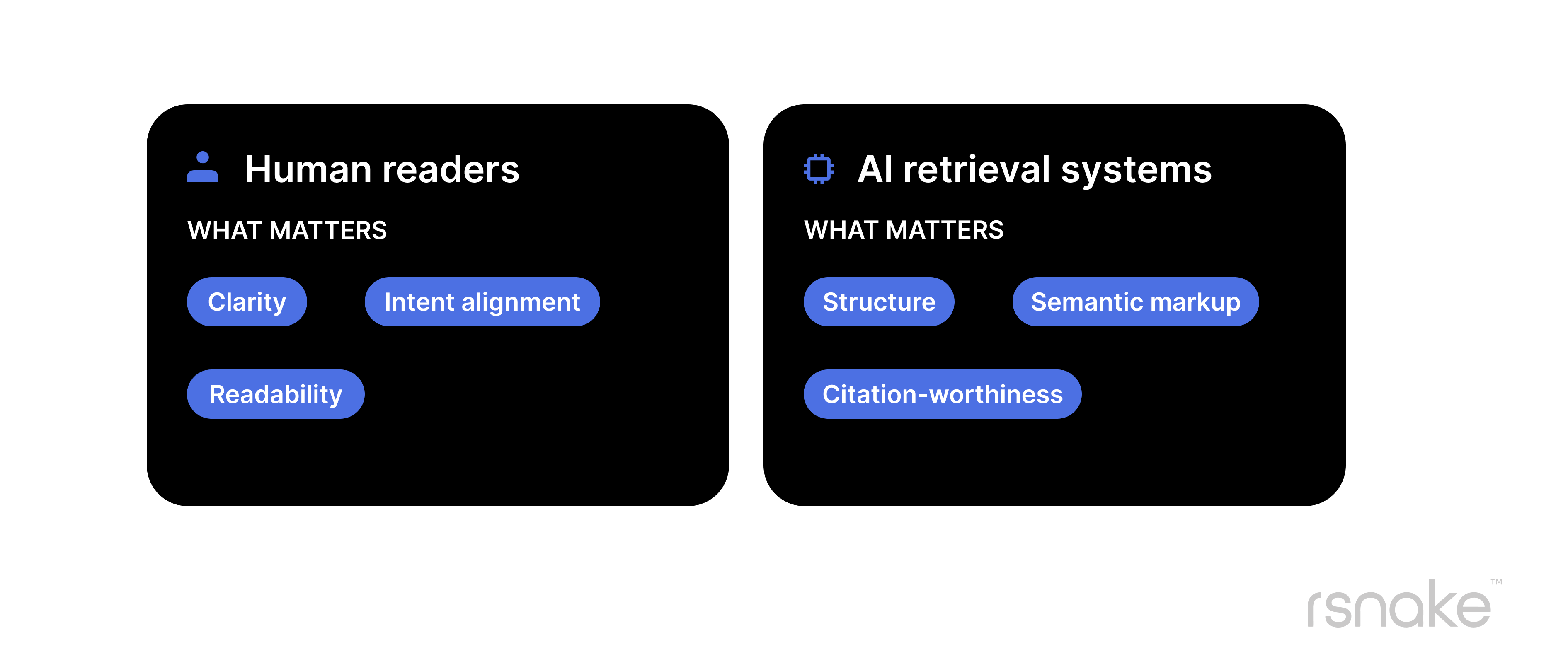
An agency that understands AI SaaS development will align product, content, and SEO from day one. The best SEO agency for SaaS startups doesn't just tweak titles; it helps you build an MVP with the right architecture, structured data and content hooks so you can rank quickly.
Comparison: Traditional SEO vs. AI‑Native SEO
At Rattlesnake, our content strategy, design, and AI Builder services exist precisely at this intersection, helping teams create digital experiences that rank, convert and earn AI citations. Get in touch if you’d like to discuss how we can work together.
Rattlesnake is a leading product design and development studio based in London. We partner with ambitious companies to build digital products, brands, and growth systems that perform.


Ready to start?
Send us an email with your project details, and our team will connect with you within 24 hours to schedule a call.


© 2020-2026 Rattlesnake Group Limited.
Rattlesnake Group Limited is a limited liability company registered in England and Wales. Registered number: 12551349. Registered address: 124 City Road, London EC1V 2NX. VAT Registration Number: 436362592.


