.svg)
MVP Build Timeline: How Long It Really Takes and What Determines the Schedule


- Most minimum viable products launch in 8–16 weeks when their scope is clear, decisions are quick, and integrations are limited.
- Faster schedules of 4–8 weeks are possible only when you know exactly what you’re building and stick to one platform; going beyond core features pushes timelines past 16 weeks.
- This guide explains what “MVP” really means, breaks down each phase, lists the factors that add weeks, and offers a simple estimator so you can plan with confidence.
Startups and product teams often ask how long it takes to build an MVP. There is no single answer because timelines depend on scope, complexity, integrations, platforms and how fast you make decisions. Across the industry, most MVPs take between two and four months. At the short end, a lean validation build can ship in four to eight weeks, but only when the core feature is well‑defined, and there are few external dependencies. At the long end, enterprise or regulated products may need six months or more.
This guide explains what “minimum viable product” actually means, shows realistic timeline ranges by complexity, breaks the work down by phase, highlights the drivers that blow out schedules, and includes a simple decision tree that helps you assess whether you’re on a lean, standard or complex track. We also discuss mobile app timelines and why Rattlesnake’s founder‑led team delivers product MVPs quickly by keeping the scope tight, working with a dedicated project manager and applying a product‑driven mindset.
What “MVP” means (and why it affects timelines)
A minimum viable product is the simplest version of a product that allows teams to validate ideas and gather feedback with minimal effort. It is the version of a new product which allows a team to collect the maximum amount of validated learning about customers with the least effort. Rattlesnake’s guide describes an MVP as a simplified first version focused on essential features to test viability. It is not a half‑built v1; it is a learning tool.
Many founders misinterpret the MVP as a stripped‑down product and try to squeeze in every nice‑to‑have. This undermines the purpose. A product MVP is meant to test a single core hypothesis, gather real user feedback and inform whether further investment is warranted. When you treat the MVP as a full product, timelines balloon because you’re essentially building v1. To stay lean, lock down one problem, define what success looks like and build only what is necessary to test that hypothesis. That discipline keeps the timeline realistic and makes the learning actionable.
The realistic timeline ranges by complexity
Industry data suggests that there is a broad range for how long it takes to build an MVP. A basic MVP can be launched in two to twelve weeks; enterprise builds can stretch to six to twelve months. These ranges vary by complexity:
- Lean validation (4–8 weeks) – A single‑purpose web or mobile MVP with three to five core features, one user type and no complex integrations fits here. T3C.ai notes that simple MVPs are often delivered in 2–4 weeks. To hit this timeline, you need a locked scope, no more than one platform and fast decision cycles.
- Commercial (8–16 weeks) – Medium‑complexity products such as SaaS platforms or two‑sided marketplaces with multiple user roles, third‑party integrations and a custom UI take longer. Development agencies estimate 4–8 weeks for the build phase alone, so the overall discovery‑to‑launch timeline usually sits between two and four months. Rattlesnake typically delivers MVPs in this window when there is clear prioritisation and a dedicated product manager.
- Complex or regulated (16–28+ weeks) – Marketplace apps with many integrations, machine‑learning components or regulated fintech and healthcare products require extensive planning, security audits and compliance. Vivasoft’s guide points out that enterprise‑level MVPs in regulated industries can take five to ten months. For these builds, expect multiple teams, formal testing cycles and iterative approvals.
- Rattlesnake’s differentiator is scope discipline. For well‑defined products, we compress the timeline into a 4–12‑week delivery track by keeping decisions lean, overlapping design and engineering work, and limiting integrations.

The MVP build process by phase (with typical durations)
Every successful MVP follows a sequence of phases. While different teams have their own frameworks, the following five‑phase model maps closely to reality. The phases often overlap; design can start while discovery is wrapping up, and testing can begin before all features are done.

Discovery & scoping (1–3 weeks)
This phase involves research, user interviews and turning your idea into a clear problem statement. A well‑run discovery can be completed in 1–2 weeks, but unclear goals can extend it. Outcomes should include locked scope, acceptance criteria and an agreed definition of release. Rattlesnake’s founders engage directly with clients during discovery to ensure the scope reflects real‑world needs.
UX/UI and prototyping (1–3 weeks)
Designers translate requirements into user flows and clickable prototypes. When design systems and UI kits already exist, this takes 7–10 days. If product decisions are unresolved, expect longer. Rattlesnake works in Figma with an atomic design system and provides a full UI kit upfront so that prototypes align with future development.
Engineering build (4–10+ weeks)
Engineers develop the backend, frontend and integrate third‑party services. Agile sprints allow early demos and course correction. The build phase for medium‑complexity apps typically lasts 4–8 weeks. Integrations and data complexity often drive this timeline more than core features. Rattlesnake uses a dedicated project manager and experienced unicorn‑level engineers to keep momentum high.
QA and hardening (1–3 weeks)
Testing is not optional. Quality assurance includes functional, user acceptance, performance and security testing. External guides suggest allocating 1–2 weeks, but small teams may need up to 3–4 weeks.
Launch and instrumentation (3–7 days)
This final phase involves deploying to production, setting up analytics and error monitoring, and rolling out to a limited group of users. A controlled launch helps catch issues quickly before scaling.
What drives MVP timelines up or down
Some factors have an outsized impact on schedules. Understanding these drivers helps you set realistic expectations and identify where to stay lean.
- Number of features – Each additional feature adds development and testing time. T3C.ai notes the relationship is exponential. Prioritise ruthlessly; if a feature doesn’t test your core hypothesis, defer it.
- Integrations – Simple APIs like Stripe take a few days, while complex systems can add one or two weeks. Minimise external services or delay them to later versions.
- Data complexity – A simple CRUD app moves fast; complex data models and real‑time syncing add weeks. Start with a lean schema and expand after validation.
- Regulation and security – Compliance in sectors like fintech or healthcare can add six months. Engage compliance specialists early and use certified infrastructure.
- Platform count – Each additional platform (web, iOS, Android) adds weeks. Starting with a web app or progressive web app allows you to validate without parallel mobile builds.
- Team experience – A senior team that has built similar products moves faster. Junior teams or solo founders may take twice as long.
- Decision speed – Slow feedback loops can turn a six‑week project into a ten‑week one. Empower a product owner to make timely decisions.
- Scope clarity – Unclear scope is the single biggest cause of delays. Rattlesnake insists on scope discipline; without it, even small MVPs slip.
How long does it take to build an MVP app specifically?
Building a mobile MVP takes longer than building a web MVP because it includes platform work, device testing and store release steps.
An MVP is meant to be the simplest usable version of a product that allows teams to learn from real users with minimal effort. When applied to mobile, that simplicity must still account for:
- iOS or Android environments
- device compatibility
- performance testing
- submission to Apple App Store or Google Play
Following the standard MVP process, defining the problem, prioritising core features, designing user flow, developing and testing, a mobile build typically moves through five phases:
In practice, this means: A focused mobile MVP usually takes around 8–16 weeks.
App store review cycles also add unpredictability. Apple and Google may take a few days to approve new apps, and rejections reset the clock. To stay lean, launch as a progressive web app first; once you have validation, invest in native versions.
Common timeline myths (and what they cost you)
- “We’ll skip discovery to go faster.” Skipping research usually leads to rework when assumptions prove wrong. A week of discovery saves months of rebuilding.
- “We’ll add features after launch.” Many founders keep building while calling it an MVP. Without a scope lock, the product never reaches the market and timelines double.
- “AI coding tools halve the timeline.” Generative tools can speed up boilerplate tasks, but integration, testing and product decisions still take time. Expect modest gains, not magic.
- “We need all platforms at once.” Starting with a web or a single platform lets you test quickly. Expanding to iOS and Android later does not limit your ultimate reach.
- “Timeline estimates are fantasies.” A disciplined process with clear inputs, scope and decision‑making produces reliable ranges. Use the estimator below to sanity‑check quotes.
A simple estimator readers can use before speaking to an agency
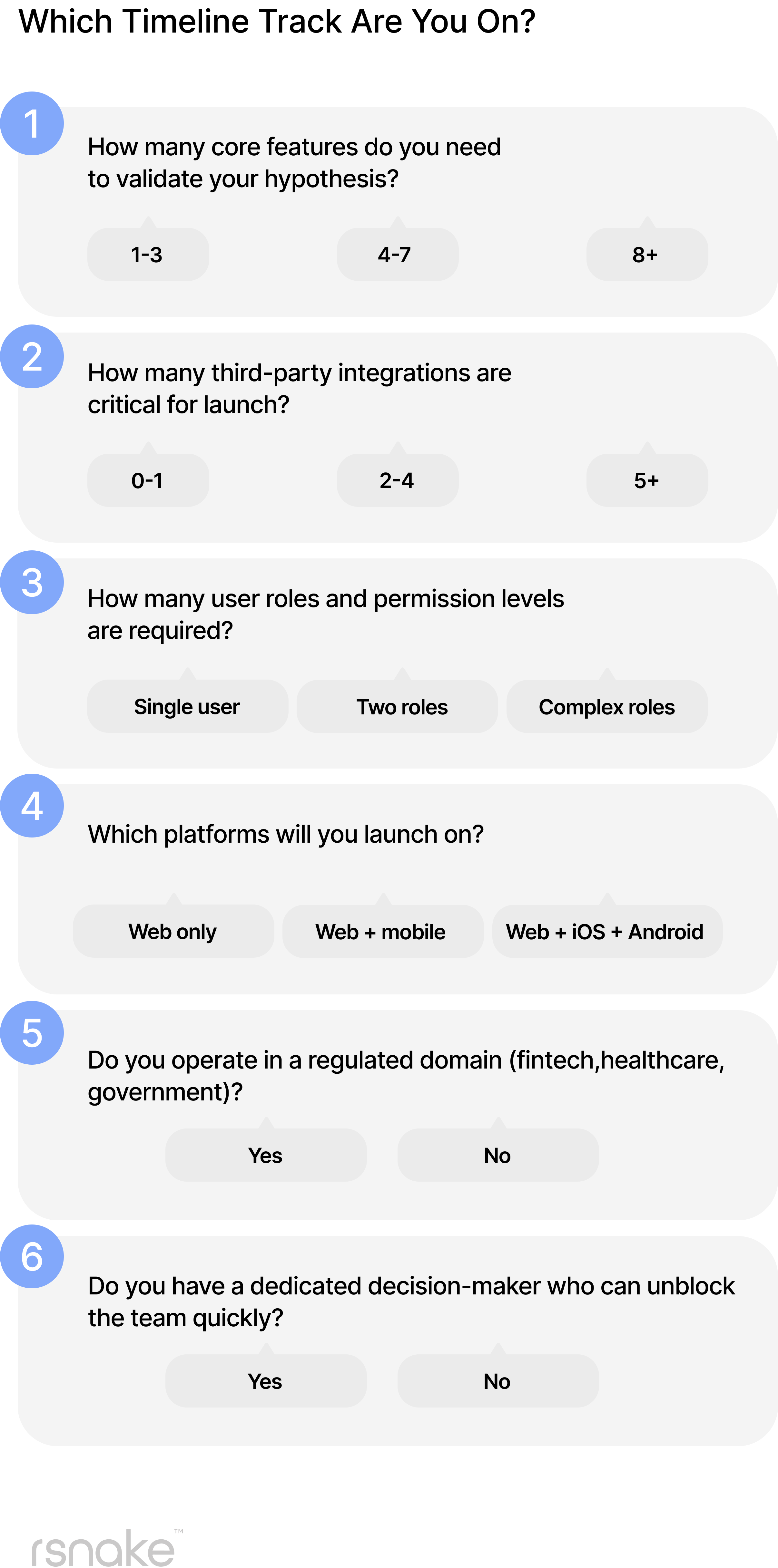
Count the number of “higher‑complexity” answers. If most answers are in the simplest bucket, you’re on the Lean track (estimate 4–8 weeks). A mix of simple and moderate answers puts you in the Standard track (8–16 weeks). Multiple high‑complexity answers push you to the Complex track (16+ weeks). Use this as a conversation starter with your development partner.
When to use an MVP development partner vs build in‑house
If you have an experienced in‑house team ready to start, building your own MVP can work, but consider the hidden timeline: recruiting engineers can take months before coding starts. An agency compresses the start‑up time because the team is already in place; however, it only works when stakeholders make decisions quickly and respect the agreed scope.
Agencies also bring design systems, pre‑built components and proven processes that accelerate delivery. When your product idea needs to be validated fast, an MVP development service with a strong product mindset often saves time and money.
Examples: three MVP timelines from concept to launch
- B2B SaaS with one integration – Scope: user management, dashboard, Stripe billing. Team: PM, designer, two engineers. Timeline: Discovery 1 week, design 2 weeks, build 6 weeks, QA 2 weeks, launch 1 week. Delay driver: slow decision on billing model added 1 week.
- Marketplace with two‑sided logic – Scope: buyer and seller portals, chat, escrow integration. Team: PM, designer, four engineers, QA. Timeline: Discovery 2 weeks, design 3 weeks, build 8 weeks, QA 3 weeks, launch 1 week. Delay driver: third‑party escrow API integration added 2 weeks.
- Regulated fintech MVP – Scope: onboarding, KYC, payments, reporting. Team: PM, designer, backend, mobile, QA, compliance consultant. Timeline: Discovery 3 weeks, design 4 weeks, build 12 weeks, QA & security audit 6 weeks, launch 2 weeks. Delay driver: compliance review cycles and data‑security hardening.
Move Forward With Clarity
An MVP timeline is not fixed. It depends on scope, decisions, and how focused the first version of the product is. When priorities are clear and the problem is well defined, a product MVP can move faster and with fewer surprises. When they are not, timelines stretch, and momentum slows.
If you are trying to understand how long does it takes to build an MVP for your idea, the most useful step is to assess where your scope stands today.
If you’re preparing to build an MVP and want a realistic timeline before committing resources, book a call with our team. We’ll review your idea, discuss what your MVP needs to include, and outline what it would take to move from concept to launch.
Rattlesnake is a leading product design and development studio based in London. We partner with ambitious companies to build digital products, brands, and growth systems that perform.


Ready to start?
Send us an email with your project details, and our team will connect with you within 24 hours to schedule a call.


© 2020-2026 Rattlesnake Group Limited.
Rattlesnake Group Limited is a limited liability company registered in England and Wales. Registered number: 12551349. Registered address: 124 City Road, London EC1V 2NX. VAT Registration Number: 436362592.


