.svg)
How to Build a Unique Value Proposition (UVP) for Your Startup

- A UVP clearly explains who your product is for, what problem it solves, and why it’s different. It goes beyond a slogan, aligning product, marketing, and brand around one clear promise.
- Strong UVPs are built on customer insight, not assumptions. Research, interviews, and tools like the value proposition canvas help translate real pains into meaningful benefits.
- A good UVP drives positioning, product decisions, and growth. When tested and refined, it improves clarity for customers, confidence for investors, and speed toward product–market fit.
Introduction
In crowded markets, your product needs more than features to stand out. A Unique Value Proposition (UVP) articulates why people should care. It answers three simple questions: Who are you serving? What problem do they face? How do you solve it better than anyone else? Without a clear UVP, teams drift, investors hesitate, and customers move on. This guide offers a practical framework for developing a compelling UVP and shows how
Rattlesnake Group helps founders build messages that resonate. You’ll learn how to research your market, map insights with a value proposition canvas, craft a concise UVP statement and test it with real users. We’ll also look at value proposition examples for startups and pitfalls to avoid, so your message is both memorable and meaningful.
What Is a Unique Value Proposition (UVP)?
A UVP is a concise statement that communicates the value and difference of your product. It is broader than a unique selling proposition (USP), which often focuses on a single feature. A UVP blends the problem you solve, the benefits you offer and the emotional connection you create. It should be clear, customer‑focused, differentiated and credible. Think of it as the promise at the centre of your brand strategy; it sits on your homepage, pitch decks and social profiles.
A succinct UVP sits on your website’s hero section, investor pitch decks and social profiles, reinforcing a consistent message wherever people encounter your brand.
UVP vs. USP
Many people use “UVP” and “USP” interchangeably, but they serve different purposes. A USP is about a single point of difference, for example, “the only toothpaste with charcoal whitening”. It’s often feature‑driven and can be copied by competitors. A UVP, by contrast, combines the problem, solution, emotional benefit and proof. It is broader, tying together who you serve, what you solve and why you are the best choice. In short, UVP vs USP is the difference between a holistic value promise and a catchy slogan. This distinction is important when writing your startup messaging framework because it helps you avoid superficial claims.
Why Every Startup Needs a Strong UVP?
A well‑defined UVP brings clarity and focus:
Aligns Your Team
Startups often evolve quickly, pivoting between ideas and customer segments. Without a startup value proposition to anchor decisions, teams can become misaligned. A clear UVP aligns product, marketing and design around one promise. It acts as a compass, ensuring features and campaigns serve the same target audience and solve the same problem. When your developers, designers and marketers share an agreed UVP, you avoid wasted time and build cohesive experiences.
Attracts Investors and Customers
Investors hear hundreds of pitches. What makes them lean forward? A founder who articulates a compelling value proposition statement: “We solve this painful problem for this audience in a way others can’t.” A strong UVP shows clarity of thought and market understanding, which increases investor confidence. For customers, a UVP answers the unspoken question “Why should I care?” The result is higher conversion rates, better retention and more word‑of‑mouth referrals.
Improves Brand Positioning
Your startup brand positioning defines how people perceive you relative to competitors. A UVP sits at the heart of that positioning. By articulating the core benefit and differentiation, you shape expectations and experiences. When aligned with your company’s personality and values, the UVP helps build trust and emotional connection. For example, Figma’s real‑time collaboration features enable multiple designers to work together simultaneously. Their UVP emphasises shared creativity and modern workflow, setting them apart from static design tools.
Drives Product‑Market Fit
Product‑market fit occurs when you deliver the right product to the right people at the right time. A strong UVP clarifies who the “right people” are and what “right” means. It forces you to prioritise features that deliver on your promise and ignore distractions. Teams that iterate their UVP based on feedback often reach product‑market fit faster than those who chase features without a clear story.
Example: UVPs Fuel Growth
Consider how companies such as Slack, Revolut, Notion and Canva have used their UVPs to accelerate growth:
- Slack: Their mantra, “Be less busy”, summarises how the platform reduces workplace busyness by streamlining communication. It aligns with the pain of scattered emails and meetings.
- Revolut: CEO Matt Baxby explains that Revolut’s mindset is “one app, all things money,” aiming to manage the entire financial life of its users, from budgets to crypto. The UVP reflects a holistic financial hub.
- Notion: Described as “the connected workspace where better, faster work happens”, Notion promises an integrated note‑taking and project management experience.
- Canva: Their statement “Empowering the world to design” conveys that anyone can create professional designs effortlessly.
- Airbnb: The phrase “Belong anywhere” is not just a slogan but a promise of community and belonging. It shifts focus from lodging to experiences.
These examples demonstrate how a well‑crafted UVP can shape brand narratives, attract loyal users and differentiate products.
The Core Elements of a Powerful UVP
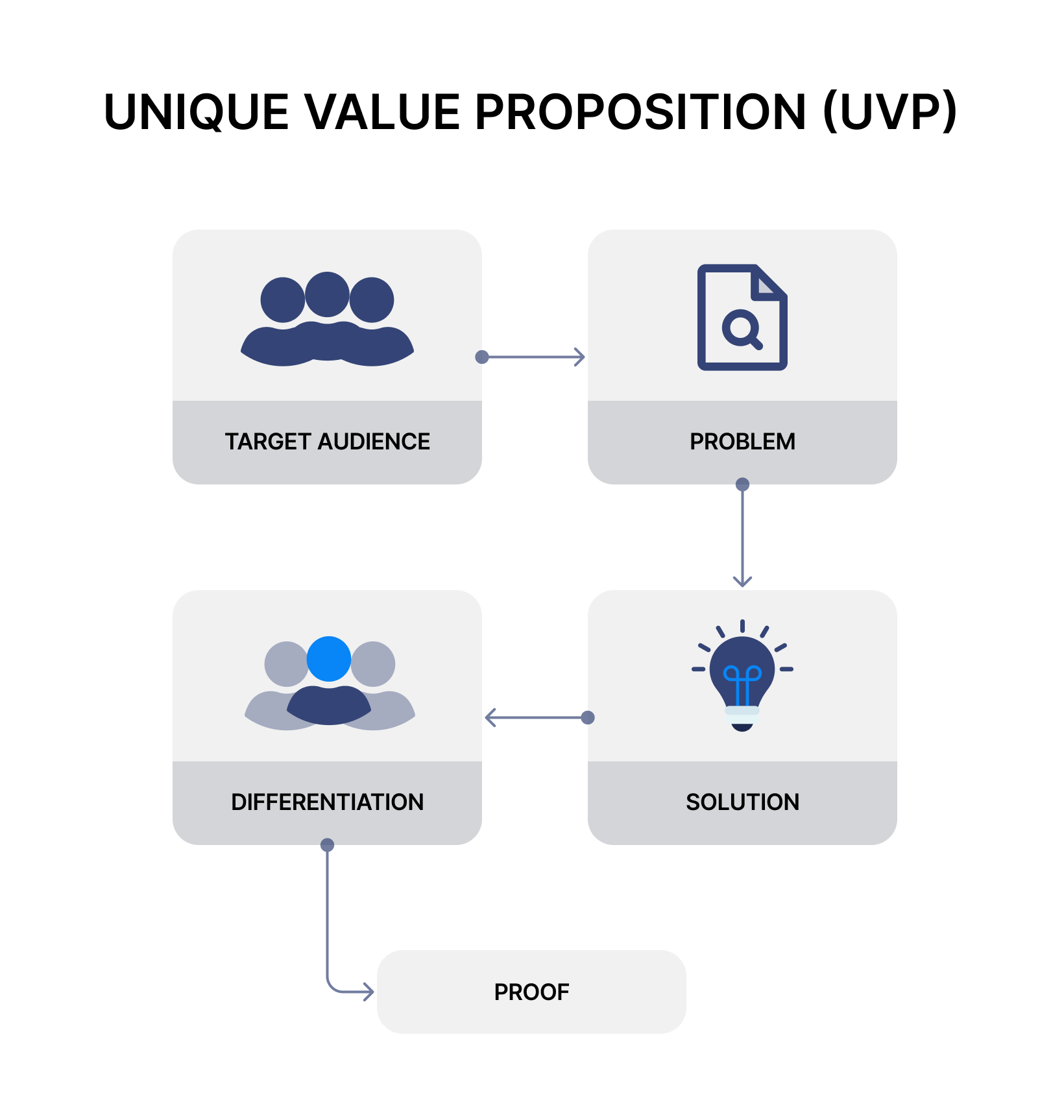
While every company is unique, powerful UVPs share common building blocks. Understanding these elements will help you craft a statement that resonates.
1. Target Audience
Be explicit about who your product is for. A targeted audience ensures your promise speaks directly to the people who will benefit most. Avoid vague terms like “everyone” or “businesses.” Instead, specify the segment (for example, “remote software teams,” “busy parents,” or “millennial travellers”).
2. Problem Statement
A UVP starts with a clear description of the pain point or unmet need. What keeps your audience awake at night? What tasks are frustrating or time‑consuming? Your problem statement should be grounded in real customer insights gathered through interviews, surveys and behaviour data.
3. Solution & Benefit
Explain what you do and how it helps. This is more than a feature list; it focuses on the outcome for your customer. For instance, instead of saying “We offer cloud storage,” you might say “We give remote teams one secure place to store and share files.” It’s about the benefit, not the technology.
4. Differentiator
Why should someone choose you over another solution? Your differentiator could be speed, simplicity, design, community or a unique technology. It must be meaningful and relevant to the problem. Focusing on what makes you “only” or “first” helps crystallise your differentiation.
5. Proof
People trust evidence. Include social proof (testimonials, case studies, reviews), metrics (growth numbers, funding rounds, retention rates) or certifications to validate your promise. Proof adds credibility to your UVP and reduces risk in the mind of your audience.
How to Build a Unique Value Proposition (Step‑by‑Step Framework)
Developing a UVP is not about dreaming up catchy phrases. It is a systematic process that blends research, creativity and iteration. Follow these steps to build a compelling proposition for your startup.
Step 1: Research Your Market and Customers
Before writing anything, immerse yourself in your audience. Conduct qualitative interviews, surveys and behavioural observations. Tools like Typeform for surveys and Hotjar for heatmaps help gather insights. Analyse competitor messaging to find gaps. Ask:
- What problems are customers trying to solve?
- Which solutions do they currently use, and what frustrates them?
- What words do they use to describe their needs?
Compile your findings into a customer insight database. Use this research to inform your problem statement and differentiation.
Step 2: Map Insights Using the Value Proposition Canvas
The value proposition canvas helps visualise how your solution matches customer needs. It includes a Customer Profile and a Value Map. In the customer profile, list the gains (desired outcomes), pains (frustrations) and jobs (tasks to be done). In the value map, list your products and services, pain relievers, and gain creators. Match each customer pain to a pain reliever, and each desired gain to a gain creator. This exercise reveals which features matter most and which can be deprioritised.
Step 3: Define What Makes You Different
Once you know your audience and their challenges, identify your startup’s differentiation. This is your answer to “Why us?” and a crucial step in learning how to define your value proposition. Use the “Onlyness Statement” from brand strategist Marty Neumeier: “Our startup is the only [category] that [unique benefit] for [audience].” Listing emotional and functional differentiators helps. For example, Revolut emphasises convenience and breadth of financial services, while Canva stresses democratising design.
Step 4: Craft Your UVP Statement
Now that you have insights, craft a concise value proposition statement. Aim for one or two sentences. It should clearly state the target audience, the problem, the solution and the differentiator, using language that resonates with your readers. Avoid jargon and keep it conversational. Here are some breakdowns:
- Airbnb — “Belong anywhere.” The pain: travellers feel like outsiders. The benefit: feeling at home wherever you go. The differentiator: a community‑driven marketplace.
- Notion — “The connected workspace for your notes, tasks and projects.” The pain: information scattered across tools. The benefit: one integrated space for better, faster work.
- Calendly — “Automate your schedule.” The pain: back‑and‑forth emails. The benefit: simple scheduling. The differentiator: seamless integration with calendars and workflows.
Start with the formula, then refine. A good practice is to write several versions and ask customers which one feels most compelling. Aim for clarity over cleverness; a crisp message often beats a witty one.
Step 5: Test and Validate Your UVP
Once you have a draft, test it. Put the UVP on your landing page and run A/B tests to see which version drives more sign‑ups or click‑throughs. Use ads to gather early feedback and refine the wording. Conduct interviews and ask customers if the statement resonates. Track metrics like click‑through rates, sign‑up rates and retention. Iterate based on data. According to Startup Savant, refining and testing your UVP is essential for finding the phrasing that truly resonates.
From UVP to MVP (where most teams lose time). A UVP isn’t just a messaging exercise; it’s a product decision filter. Once you’ve tested the promise, the next step is building an MVP that expresses it clearly in the user journey, feature priorities, and onboarding. That’s where cross-functional work matters most: design, development, and go-to-market need to move together, not in a relay.
If you’re turning a validated UVP into a build plan, the Rattlesnake, London team shares how we approach MVP development end-to-end
Examples of Effective Startup UVPs
Looking at successful companies can inspire your own UVP. Here are a few more examples beyond those mentioned earlier.
Slack: “Be less busy”
Slack’s UVP captures the frustration of information overload and endless meetings. By promising to make people “less busy,” it emphasises a life‑changing benefit: reclaiming time. The solution, a shared workspace where conversations, files and tools live together, is implied. The simplicity of the phrase is part of its power. Slack’s startup messaging framework further reinforces this by highlighting channels, integrations and search features.
Revolut: “One app, all things money”
Revolut’s UVP addresses the fragmented nature of personal finance. Customers juggle bank accounts, cards, crypto wallets and budgeting apps. Revolut positions itself as the all‑in‑one finance hub. Their value proposition appeals to convenience and control: users can exchange currencies, invest, budget and manage their children’s allowances in one app. The differentiator is breadth; few competitors offer such an integrated suite.
Notion: “The connected workspace where better, faster work happens”
Notion acknowledges that knowledge workers use multiple tools for notes, tasks and projects. Its UVP promises a connected workspace that accelerates work. By positioning itself as the place where “better, faster work happens,” Notion emphasises both quality (better) and efficiency (faster). The differentiator is integration: notes, tasks and databases live in the same environment.
Canva: “Empowering the world to design”
Canva’s message speaks to non‑designers who feel intimidated by traditional graphic design software. It promises empowerment: anyone can create professional‑quality designs easily. The differentiator is simplicity; Canva reduces friction with templates and drag‑and‑drop tools. Their call to “empower the world” also hints at a mission, which appeals to investors and partners. This clarity makes it an ideal UVP template for startups seeking to blend accessibility, emotion, and purpose into their messaging.
Figma: “Design where teams collaborate in real‑time”
Though Figma’s tagline varies, its UVP revolves around live collaboration. It solves the pain of designers working on files in isolation, sending versions back and forth. Figma’s platform allows multiple people to design and comment simultaneously, turning design into a real‑time conversation. The differentiator is synchronous collaboration in the browser.
Calendly: “Schedule without the back‑and‑forth”
Calendly’s UVP tackles the tedium of finding a meeting time. Automating scheduling removes emails and friction. The differentiator is ease of integration with calendars and the simple, shareable booking link. It speaks to busy professionals who crave efficiency.
Putting It Together
Studying these startup value proposition examples shows common themes: clarity, a clear benefit, emotional resonance and a point of difference. Use them as inspiration, but avoid copying slogans. Instead, tailor the structure to your context and infuse your personality. Remember, authenticity matters.
Common Mistakes When Defining Your UVP
- Focusing on features, not benefits – Customers care about outcomes, not technical specs. Translate features into human benefits.
- Using vague or generic language – Avoid phrases like “world‑class” or “innovative” without evidence. Be specific and concrete.
- Copying competitor messaging – What works for another startup may not suit your audience. Use competitor research to differentiate, not imitate.
- Neglecting customer insight validation – Assumptions can mislead. Test your UVP with real users and adjust based on feedback.
- Writing long, complex statements – A UVP should be brief. Resist the urge to cram multiple benefits into one sentence.
By avoiding these pitfalls, you create a proposition that is meaningful and memorable.
How to Use Your UVP Across Brand and Marketing Channels
Once you have a strong UVP, integrate it consistently across your brand. Here is how:
- Website hero section – Place your UVP prominently on the homepage, ideally within the first screen. Pair it with a clear call‑to‑action. For example, Slack’s home page uses “Be less busy” followed by a sign‑up button.
- Investor pitch decks – Open your deck with your UVP to capture attention. It sets the narrative for the problem you solve and the market opportunity.
- Social bios – Summarise your UVP in your Twitter and LinkedIn bios to attract followers who resonate with your mission.
- Paid ads – Use the UVP as the headline in search and social ads to qualify clicks. People who relate to the promise are more likely to convert.
- Email signatures and brand collateral – Including a short version of your UVP in signatures and packaging reinforces brand identity.
Ensure that all messaging across channels aligns with the core promise. Over time, consistency builds trust and recognition.
Final Thoughts
A Unique Value Proposition is the anchor of your brand. It distils your mission into a promise that resonates with customers, investors and employees. Building a UVP requires research, creativity and iteration, but the payoff is clarity and alignment.
Rattlesnake Group helps founders craft compelling UVPs through research workshops, customer interviews and collaborative sessions. As a boutique, founder‑led studio, they know how critical messaging is for early‑stage products. Their ‘founders to founders’ approach ensures every word reflects the real‑world needs of your audience. Remember: a great UVP is brief, specific and believable. When done right, it becomes the thread that ties your product, brand and marketing together, a compass for growth.
Rattlesnake is a leading product design and development studio based in London. We partner with ambitious companies to build digital products, brands, and growth systems that perform.


Ready to start?
Send us an email with your project details, and our team will connect with you within 24 hours to schedule a call.


© 2020-2026 Rattlesnake Group Limited.
Rattlesnake Group Limited is a limited liability company registered in England and Wales. Registered number: 12551349. Registered address: 124 City Road, London EC1V 2NX. VAT Registration Number: 436362592.


