.svg)
AI Development Services for Startups: What to Build vs What to Buy in 2026


- Renting core infrastructure and managed ML services frees your team to focus on your product. Off‑the‑shelf APIs and databases cost pennies per request and get you to market in weeks, not months.
- Build the layers that create your competitive advantage: custom orchestration logic, domain‑specific fine‑tuning, evaluation pipelines and user‑facing experiences. These are where generative AI development services deliver value.
- AI‑generated code introduces hidden risks, security flaws, phantom dependencies and mounting technical debt. A responsible partner reviews every pull request, documents everything and transfers full IP rights to you.
Choosing the wrong AI development services in your first year costs more than the tool itself; it costs the runway you needed to validate product‑market fit. Build‑versus‑buy is not a technical choice; it is a capital allocation decision, and most founders make it backwards. This guide gives you a working framework for 2026: which layers of your AI stack to own, which to rent, and where the risks of AI‑generated code can quietly undermine both.
AI development services are the custom engineering work that sits between a foundation model and a working product, fine‑tuning, orchestration, evaluation and integration that turn an API into something shippable. In 2026, pre‑trained models are available via API at pennies per request, and hyperscalers have invested hundreds of billions in GPUs, so you don’t have to.
Your constraint is focus; rent the lower layers and invest your time in what differentiates you. Unlike 2022, when training a custom model was often the only way to achieve reliable performance, today, a founder can integrate a production‑grade generative AI layer in a weekend using managed APIs.
Why the Build‑vs‑Buy Question Is Different for Startups in 2026
Startups don’t have the same realities as enterprises: those frameworks assume deep pockets, big teams and multi‑year horizons. Pre‑Series B founders have a handful of engineers and a limited runway. In this context, speed matters more than owning every line of code.
The cost of foundational layers has collapsed: you can integrate a production‑grade generative model in a weekend. Infrastructure investment is being absorbed by hyperscalers. Microsoft, Amazon and Google have each committed tens of billions annually to AI-driven data centres, while analysts such as Gartner project global AI spending to exceed $300 billion per year. Startups are effectively renting infrastructure built at a scale they could never justify. Those GPU clusters are funded by others, so renting them is rational. The question is no longer whether to buy the foundation; it is how much to build on top.
Why AI development services are now about product execution, not model ownership
The biggest change in 2026 is not that AI models became more powerful. It is that access to strong models has become normal. A startup no longer needs to train a foundation model to build a useful AI feature. It can use a managed model, connect it to its product, and spend its budget on the parts users actually experience.
That does not make the build easy. It changes where the hard work sits. The value is no longer in owning raw infrastructure. It is in building the product layer around the model: data flows, prompts, guardrails, evaluation, permissions, analytics and user experience.
This is where AI development services matter. They help startups move from “we can call an API” to “we have a working AI product that behaves consistently under real user conditions.” That difference is important. A demo can look impressive in a meeting. A product has to work with messy inputs, unclear user questions, changing costs and business rules.
The Four‑Layer Framework: What Always Buy, What Always Build
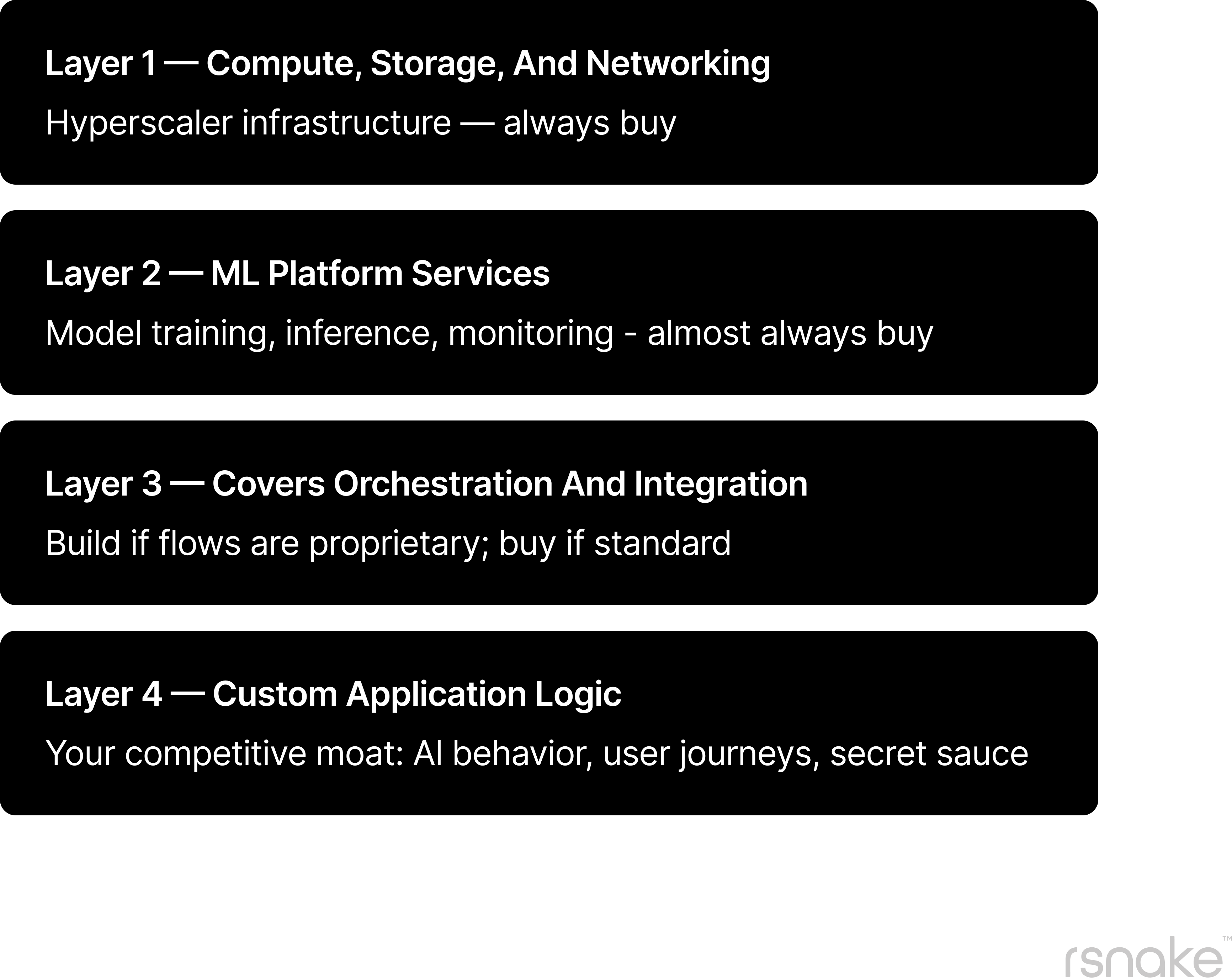
A simple four‑layer framework clarifies the build‑versus‑buy choice. At the bottom of the stack:
- Layer 1 compute, storage, and networking should always be bought. No startup should manage GPU clusters; hyperscalers handle hardware and security better.
- Layer 2 comprises ML platform services, model training, inference and monitoring. In almost all cases, this should be bought. Managed services host and scale your models; only companies whose product is the model itself should build here.
- Layer 3 covers orchestration and integration, workflows, pipelines and connectors that move data between systems. Choose based on how unique your data flows are: buy orchestration when your flows are standard; build when they are proprietary.
- Layer 4 is your custom application logic: the way your AI behaves, your user journeys and your secret sauce. This layer holds your competitive advantage and cannot be outsourced.
Hidden costs, maintenance, talent and legacy lock‑in further favour buying the lower layers.
What Startups Should Almost Always Buy in 2026
When we talk about AI software development services, we mean the work of stitching together the right tools, not reinventing them. There are categories of AI tooling that no early‑stage startup should build:
- Foundation model access. Use pre‑trained models via API. They are cheap and reliable; training your own LLM rarely makes sense.
- Vector databases. Buy a vector database; services handle indexing and similarity search better than home‑grown solutions.
- LLM observability and monitoring. Observability tools track prompt quality and latency; building your own logging stack slows you down.
- AI coding assistants. Coding assistants boost productivity but are not differentiators.
- Data preprocessing and ETL. Use existing ETL services for common formats instead of writing bespoke pipelines.
Managed APIs cut time to market from 18 months to three, often the difference between success and running out of runway.
What Startups Should Almost Always Build in 2026
The flip side of the framework shows where generative AI development services add value. These are the parts of the stack that create your moat and cannot be outsourced:
- Domain‑specific fine‑tuning. Fine‑tune your model on proprietary data to improve relevance and fairness.
- Evaluation pipelines. Generic metrics rarely match user value. Build evaluation tooling with human feedback and business metrics.
- Custom AI agents and workflows. When your process spans multiple sources and tools, build custom workflows; generic connectors can’t navigate your unique systems.
- User‑facing AI experiences. The interface and safeguards define your brand, so design them yourself.
Rattlesnake typically starts at Layer 3, turning your chosen foundation into a product. Founders stay involved while a dedicated manager handles details. We migrate code to your servers, hand over design assets and sign over IP rights. Support is flexible; you can call us without a rigid retainer.
The Risks of AI‑Generated Code in Software Development
AI coding assistants have changed how software is written, but they introduce invisible risks. AI‑generated code might contain security flaws. Without review, you risk shipping code with known CVEs baked in.
Hallucinated dependencies are another risk: about a fifth of suggested packages do not exist, creating a supply‑chain attack surface; open‑source models are more prone to hallucination. Dependency scanning and manual verification catch these issues before production.
A startup that ships AI‑generated code without a review process is not moving faster than its competitors; it is accumulating invisible risk that surfaces during due diligence or a security incident.
The third risk is technical debt: AI‑assisted development doubles code churn and increases copy‑paste; maintenance costs can quadruple within two years. Code that “works” today may be unmaintainable tomorrow. The solution is not to ban AI but to wrap it in human oversight, enforce reviews, test coverage and dependency controls. Rattlesanke documents every endpoint, implements RBAC and audit logs, and never ships code you can’t maintain.
AI software development services should cover the layer between the API and the user
“Just use an API” is not a complete product strategy. An API gives access to a model. It does not decide how your system should behave when the user asks a vague question, uploads poor data, requests something outside the scope, or receives an output that needs review.
That gap is where AI software development services become necessary. The work includes prompt architecture, retrieval logic, fallback behaviour, user permissions, usage limits, cost controls and monitoring. These are not decorative layers. They decide whether the AI feature is reliable enough to ship.
This also affects cost. Model usage can look cheap at the start, but production usage changes the equation. A single request may include a long prompt, retrieved documents, conversation history and a detailed output. Without caching, routing and evaluation, costs can rise quickly while quality stays inconsistent.
A proper build should answer practical questions before launch. What happens when the model is unsure? Which data can each user access? How do we measure a good answer? When does a human need to review the output? Which logs do we keep for debugging? These decisions turn an AI integration into a real product.
Generative AI development services should focus on workflows, not novelty
The best use of generative AI development services is not adding AI because the market expects it. It is improving a specific workflow. That may mean reducing manual review, helping users understand complex data, generating first drafts, summarising documents, classifying requests or guiding the next action.
The difference matters. A generic chatbot rarely creates lasting value. A workflow-aware AI feature can. For example, a legaltech product may need AI that reads clauses, flags risk and keeps a human in the loop. A fintech platform may need AI that explains financial data without making unsupported claims. A healthcare product may need controlled outputs, audit trails and strict access rules.
In each case, the model is only one component. The real product is the workflow around it. That includes the data source, the prompt structure, the evaluation method, the interface and the escalation path when the model should not answer.
Two startups can use the same foundation model and get very different results. One builds a thin wrapper. The other builds a system that understands the user journey, handles edge cases and measures output quality. The second company is building software. The first is only calling a model.
How much does custom AI software development cost for a startup in 2026?
Custom AI software development for a startup in 2026 usually starts around £15,000–£25,000 for a focused proof of concept, moves to £40,000–£80,000 for a production MVP, and can exceed £100,000 when the product needs complex integrations, RAG, multi-step AI agents, security controls, evaluation pipelines, or compliance work. The model itself is rarely the highest cost.
Official pricing from OpenAI, Anthropic and Google shows that startups can rent advanced models through usage-based APIs, while Gartner forecasts $2.52 trillion in worldwide AI spending in 2026, with AI infrastructure alone adding $401 billion as providers build the foundation others will use. In plain terms: startups are not paying to build the foundation anymore; they are paying for the product engineering around it, data connections, workflows, guardrails, testing, monitoring and user experience.
The useful question is not “how much does AI cost?” It is “What level of reliability do we need before users touch it?” A demo can be built cheaply. A real product needs evaluation, fallback logic, role-based access, logging, cost controls and human review points. That is where AI development services and AI software development services become valuable: they turn model access into a product that works under real conditions, not just in a sales call. This also matches the blog brief’s direction to explain cost through startup constraints, practical scope and commercial decision-making rather than generic agency pricing.

What an AI software development company should build for startups
A good AI software development company should not push every startup toward a large custom AI build. That is usually the wrong move before product-market fit. The better approach is to start with managed infrastructure, validate the use case, and then build the custom layers that prove they deserve investment.
At the early stage, this usually means building orchestration, evaluation and product logic. Orchestration connects the model to the right data and tools. Evaluation checks whether the output is useful, accurate and safe. Product logic decides how the AI behaves inside the user journey.
This is also where design matters. AI products are not only technical systems. They are user experiences. A user needs to understand what the AI can do, when to trust it, and when to review the result. Poor UI can make a strong model feel unreliable. Clear UX can make a limited model feel useful.
The work should not be about building infrastructure for the sake of it. It should be about taking proven AI foundations and turning them into usable product logic, strong workflows and clear user experiences. That is the part startups should own, because it reflects their market, their users and their competitive advantage.
When to Bring in an AI Development Services Partner
Bring in a partner when you’ve validated a use case but lack ML expertise, when infrastructure consumes more than a third of your engineering time, or when you must ship in weeks. A good partner brings a framework, owns the outcome and builds with you, unlike generic agencies that just supply coders. Rattlesnake’s AI development services work at Layers 3 and 4, turning proven infrastructure into orchestration and application logic. We transfer full IP rights and offer flexible support without heavy retainers.
Rattlesnake is the AI software development company that builds AI software development services for startups needing to ship production AI fast, without the six‑month infrastructure project. You now have a framework to decide what to build and what to buy. When you’re ready to build what matters, talk to an AI developer at Rattlesnake.
Rattlesnake is a leading product design and development studio based in London. We partner with ambitious companies to build digital products, brands, and growth systems that perform.


Ready to start?
Send us an email with your project details, and our team will connect with you within 24 hours to schedule a call.


© 2020-2026 Rattlesnake Group Limited.
Rattlesnake Group Limited is a limited liability company registered in England and Wales. Registered number: 12551349. Registered address: 124 City Road, London EC1V 2NX. VAT Registration Number: 436362592.


